

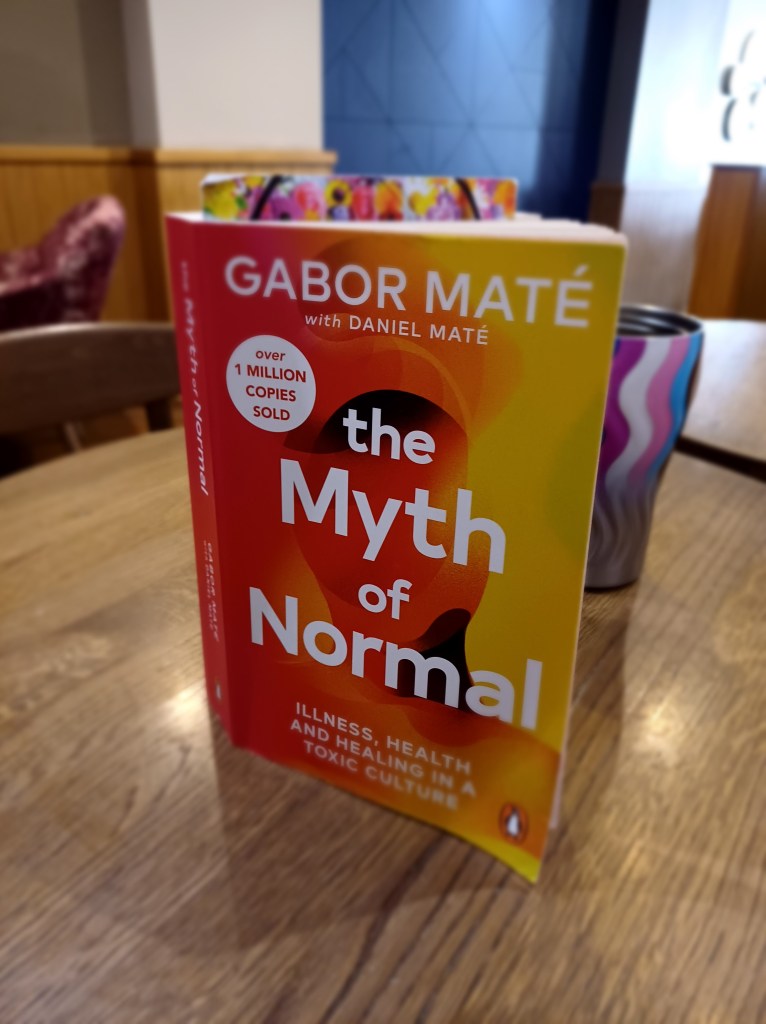
I picked up this book because it appeared to challenge, from the title, the idea of “normal” and “neuro-diverse”, which has become an interest of mine since reading Untypical several months ago.
What this book actually discusses is trauma, both personal and collective, micro and macro if you will.
It promises to be a very interesting read!
What is trauma? As I use the word, “trauma”, is an inner injury, a lasting rupture or split within the self due to difficult or hurtful events.
Page 20
Maté poses that trauma is a spectrum, with Big T Trauma (the results of catastrophic events, abuse, etc) and little t trauma (where the sufferer might not even know where the trauma came from) and psychically and physically indistinguishable from one another.
This is interesting, because there are definitely single events and prolonged periods of my life that I would argue have “traumatised” me – my father’s apparent dislike of me as a child, my husband’s illness, and my mother’s death, to make a few.
Not knowing how or what one feels … is a sure sign of disconnection from the body.
Page 27
This is a fascinating perspective as it underlines why it is so difficult to diagnose ADHD or ASD in adults: an inability to regulate, manage, or identify emotions could be neuro-divergence or trauma. Whichever the cause is, compassion is surely required.
choose vulnerability over victimhood
Page 29
Choosing to be vulnerable is to acknowledge whatever uncomfortable feelings arise from a situation, let them pass through you, and then decide what to do about them. Victimhood is to allow the feelings to control you.
Maté describes response flexibility – the ability to choose the response. I’m Alanon, I learnt the difference between response and reaction and was able to take some responsibility for my responses and defer reactions until I could determine a response. However, I often become jammed and inert, unable to select a response and trapped inside myself. Overwhelmed and shutdown: is this trauma or neuro-divergence?
The past hijacks and co-opts the present, again and again.
Page 29
I see this in my husband, who suffers for a profound and recognisable form of trauma: Post Traumatic Stress Disorder, where the past becomes the present and reality is subverted.
However, one doesn’t need to suffer from PTSD to have the past overshadow and distort the present. It’s often said of history “that rise who do not remember the past are condemned to repeat it”, however, that can apply to us as individuals: it’s so easy to act out the trauma of the past in bad behaviours of the present. By acknowledging the affects of the past, we can choose to respond rather than react.
People bearing trauma’s scars almost uniformly develop shame-based view of themselves at the core
Page 30
So many people I know carry some level of shame, a distorted view of themselves that steals hope and joy from the present and replaces it with a sense of low self-worth.
I have also suffered from this, at times I have over-compensated and had delusions of grandeur, or crushing feelings of inadequacy.
Some months back my husband said “from this moment on, shame does not live in our house” – if only that were true!
Our beliefs are not only self-fulfilling; they are world building.
Page 31
I believe that our attitude to life helps construct out reality. Bad things will happen, but they seem to happen to people who already have a sense of low self-esteem and who believe that they deserve bad things to happen, or that they are doomed to suffer bad things.
Even when bad things happen, a person with a more positive outlook will weather those things with a greater level of success, perhaps finding opportunities where another might only find problems.
Living in an immaterial world
This chapter proposes that one’s physical wellbeing is directly linked to one’s mental wellbeing. It cites a number of examples of people who lived through trauma and then experienced cancer. Or suppressed amber and developed particular types of disease.
Of particular interest to me was the relationship between trauma in childhood (eg abuse) and the development of autoimmune inflammatory diseases such as Crohn’s disease (which was mentioned explicitly) or rheumatism.
It’s of interest because I have a friend with Crohn’s who suffered a traumatic childhood, and my husband who has complex PTSD as a result of continued major traumas throughout his life.
Non-genetic inheritance
Maté discusses at some length something called “epigenetics” and uses a variety of studies to illustrate the other factors that surround our genetic legacy. It seems that how we are brought up and our environment can affect how our DNA is interpreted.
Studies on mice seem to indicate that stress can be passed across the genetic divide: the children of a stressed male mouse exhibit impaired abilities to deal with stress and illness themselves.
This has interesting implications when considered in conjunction with “Stigma: the machinery of inequality” by Imogen Taylor – stigma itself can impair the quality and length of life of it’s sufferers quite aside from the impacts of poverty and other deprivations.
a lamentable feature of western medical practice – not universal, but all too often seen – is a power hierarchy that casts physicians was the exalted experts and patients was the passive recipients of care.
Page 74
For myself, the process towards becoming a eunuch was a dead end in the UK. I encountered gatekeeping, but gatekeeping to nowhere because eunuch is just not recognised by the established medical powers. Even when I had a psychologist who backed my need for castration, there was no desire that he could open.
My friend, Tacitus, has Crohn’s diseases. He was also denied the sensible treatment for testicular torsions that also associated him. The medical establishment denied him the obvious remedy for his torsions, causing life threatening distress. He and I eventually paid to have it testicles removed by the same surgeon. What I do not know at this time, is whether his Crohn’s has improved since his surgery.
This has plagued my husband all his adult life: psychiatrists don’t even listen to him and the problems he encounter and start changing medical prescriptions without asking to understand the underlying issues that precede the symptoms. Messing with his medication causes no end of stress and anxiety – which can make him even more ill.
Chapter 6 – It ain’t a thing: disease as process
Maté is often indicating that inflammation is strongly linked with cancer. When the body is stressed, it activates the immune response – part of that response is inflammation, which is a usual and helpful way that the body prioritising blood flow to a damaged area.
However, under prolonged periods of stress this becomes a problem (I’m not clear on how from what I’ve read so far).
Sometimes cortisol is prescribed to patients to manage pain and inflammation. Cortisol is also a stress hormone.
Way back in 2004, my mum had a non-hodgkins lymphoma on her bladder. This was treated with chemo and radio therapy. She made a full recovery.
The family assumed that (aside from GP negligence), that the radio therapy was reasonable for the cancer that eventually killed her in December 2019.
Some years after her 2004 treatment, she developed arthritis in her wrists and thumbs that was debilitating. She received numerous steroid injections, which temporarily resolved the pain from the arthritis.
From what I am reading in “The Myth Of Normal”, steroid use is also linked to cancer because of its involvement in the inflammatory part of the immune system.
I am not sure how I feel about that thought.
Chapter 7 – a traumatic tension
This chapter links personality traits with types of disease. The most obvious one is the permanently angry and stressed person who suffers a coronary.
Maté explores how the nicer, more compliant types develop cancer. The people pleasers always pushing their own emotions down and putting others first.
Like my mother.
When she lay dying she was worried about my brother and me, and my father.
Maté also investigates how some people have their emotions so suppressed that they don’t even know that they are stressed – and therefore cannot do anything about it.
One such group of people are autistics. Typically, they live a life of high anxiety and stress. According to Untypical, the life expectancy of neuro-divergents is less than neuro-typicals. It would seem that one possible explanation for that is the link between stress and disease as posited in “The Myth of Normal”.
It’s worth noting that both meltdowns and shutdowns are also stress responses.
A recurring theme – maybe the core theme -n in every talk or workshop I give us the inescapable tension, and for most of us the eventual clash, between two essential needs: attachment and authenticity.
Page 105
I wasn’t expecting anything that I could relate so directly to my life, then I suddenly ran into the sentence above!
It perfectly describes my relationship with my husband.
My priority has always been attachment – looking after the relationships that I already had saved felt that I could trust, often at the expense of my husband. I hid my true self away from everybody I loved and I hid it from me because I was afraid that nobody would like me if they knew who I really was.
My husband, on the other hand, has always prioritised the truth as he perceived it. He has always been true to his boundaries and his beliefs. It’s not that he’s been unafraid to be himself, it is that he would rather be true to himself. Being authentic has cost him all of his dearest relationships. He values quality of attachment; meaning that the relationship should be authentic.
Suddenly – this time last year – my walls came crashing down and I could no longer be inauthentic.
This sudden switch in who I was to the world, blew my husband’s world apart. He thought he knew me, then he found out that … well, that it wasn’t entirely true. Hell, let’s say it: my life had been a lie.
This last year has been about me coming to terms with myself and finding out who I am. For a horribly long time, I couldn’t tell my husband anything more than “I don’t know” regarding us and our future. He has always suffered terribly with anxiety – this latest crisis nearly saw him off.
Maybe things are beginning to calm down now.
This same crisis between attachment and authenticity torments almost every LGBTQ+ person as they tear themselves apart from fear of losing their friends and family when they finally come out.
It takes work and courage to be authentic.
It takes work and courage to form authentic attachments.
My discovery is that authentic attachments are worth it.
Chapter 9
children’s sense of of security, trust in the world, interrelationship with others, and, above all, connection to their authentic emotions depends on the consistent availability of attuned, non-stressed, and emotionally reliable care-givers.
Page 126
Those of us growing up in suboptimal households, which in my case was with a father who self-medicated with alcohol to manage his stress and ASD symptoms, will therefore generally have some kind of attachment problem. For me, I can feel vulnerable and insecure very easily.
These same stresses with my father also comprised my mother’s sense of security in her marriage, which would further have affected me – especially since she would share her problems with me.
My brother is a stay-at-home dad who struggles with his own ASD symptoms, recovery from his own alcohol addiction, a girlfriend that has a number of her own mental health issues, and an autistic son, is permanently stressed and tired; the insight offered in the above quite concerns me for their young family.
To be continued…

 Eunuchorn
Leave a reply to The Myth of Normal (book review) – Part 2 – Eunuchorn Cancel reply