
While I was contemplating surgery, my friend Tacitus, recommended that I read “Stigma” by Erving Hoffman to help prepare me for life within a persecuted minority. The Evil Amazon, knowing that I’d read Hoffman’s book, suggested this book, also called “Stigma” but written by one Imogen Taylor.
A big difference that is immediately apparent is the emotional gut-punch of the introduction. This book is going to make me feel sad well as think.
The other important message that one can take from the introduction is that stigma is a tool or modern politics, which means that education alone is not enough to combat stigma:
I grew tired of hearing the claim … that challenging the stigma associated with particular conditions … can overcome ‘barriers to help-seeking’, without an acknowledgement of the ward in which stigma is deliberately designed into the systems of social provision in ways that make help-seeking a desperate task
Page 18
and
… stigma is purposefully crafted as a strategy for government …
Page 18
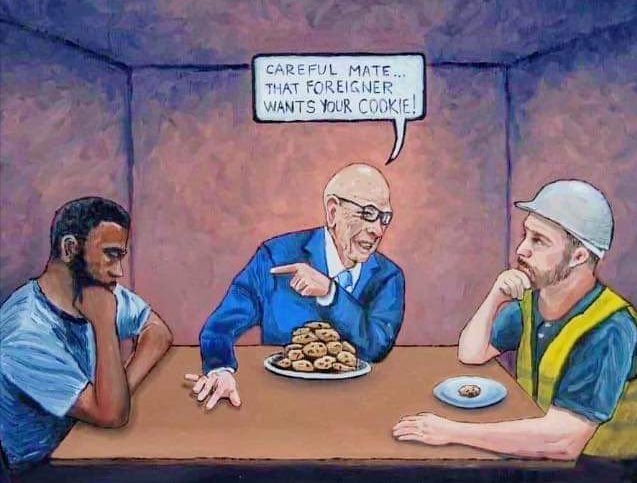
I feel that these ideas are perfectly illustrated on the right. In this image somebody, who rather reminds me of Rupert Murdoch, is sat with a pile of cookies attempting to persuade “a hard working man” that the fellow without cookies is his enemy and not himself.
I greatly enjoyed the little trek through the ancient world, where the practice of actually writing the crime upon the face l the criminal – the very origin and literal meaning of the word “stigma”. It brought back padding memories of my university days.
A correction to the text on page 36 stating that Valerian Maximus was Roman emperor from 14-37AD: Tiberius was emperor for that period; Valerian was a writer on sayings and doings. Only a classicist would be aware of these error. It does not otherwise change the accuracy of what the author writes.
The chapter on slavery in antiquity and penal tattooing conjures mixed emotions, as my knowledge of castration, eunuchs, and interest in restraint and kink originates with this aspect of history. Even in my low hormone state, I have some feelings of arousal which feel inappropriate in the context, but nevertheless are there.
… stigma is also a mechanism of patriarchal power
Page 49
The stigma Tyler relates here describes stigma as a tool used to punish and silence women, whether the medieval “scold’s bridal” or modern infective through what should be the safe and democratisating online space. Is worth noting here that the stigma that trans and non-binary people suffer is also as a result of the stigma machine of patriarchal power.
… European sailors adopted the practices of Polynesian tattooing, and began marking their identities in their skin.
Page 53
Following Cook’s exploration of the Pacific in the 1770s, sailors began to use tattoos as a means of advertising where they’d been and who they were. I have a number of tattoos that describe some of my history and my identity. The largest is a sleeve of Star Wars characters, but I have a rainbow design to celebrate my LGBTQ identity, and my mother’s fingerprints fashioned into a butterfly. I plan to have a Eunuchorn tattoo on the anniversary of my castration – again, advertising my identity, although somewhat obscurely. Many eunuchs course to have a tattoo somewhere on their body to celebrate their identity.
I was astonished to learn in the chapter “The Penal Tattoo” section on “branding the vagabond, badging the poor” that even in Elizabethan times permitted an unemployed person to be indentured or enslaved on English soil! This chapter covers a lot of detail about enclosures in the 17th and 18th century, and the horrific laws that prepared the lowest classes to be moved from substance farming to become slaves of wage.
It comes to something, when the king (George III) has to step in to block the more disgusting proposals from the rich for enslaving the poor (page 68). The book reputes the view of a peaceful transition from an agricultural population to an urban population, giving context to the various revolts in England and Wales in the 17th and 18th centuries.
The idea of the British in India being some kind of benign force (as if anybody still believes that) takes a further battering, as the British from the existing castle system and added their own horrific abuses to it using the (at the time) modern ideas of a criminal by birth to create whole new groups of people to subjugate.
…we can rarely, if ever, disentangle stigma power from the regimes of patriarchy.
Page 143
Women must be kept in their place. Men who sell to become women are their a threat, was one site never be able to willingly resign one’s masculinity nectar that is a threat to the patriarchy. Women who seek to become men are an even greater threat, since they would imply that a woman was, at her core, the equal of a man. Non-binaries are therefore anathema to the patriarchy, since (whether AMBULANCE or AFAB) they reject all boundaries and constraints on gender – which is the cornerstone of the patriarchy’s power.
The imagined anonymity of internet forums, and devices such as the user of fabricated user names, offer licence to break social taboos on racist speech, and Sam opportunity to craft recital in virulent ways.
Page 150
I have in multiple occasions been the victim of online abuse. As Taylor states, the online arena offers an opportunity, via anonymity, to “break social taboos” and say the things that they think but cannot express in real life. They are others doing the same, and join in the virtual beating, feeling empowered and that they are acting with like-minded people.
Such abuse of the gift of anonymity in the online world creates real damage in the physical world. A few people are so injured after such attacks, that they self-harm or take their own life.
However, I have personally benefitted from anonymous online safe spaces, as have all of my friends in the eunuch community, that I fear any attempt to compromise that security. Without this space, I believe that I would not have survived.
From stigma power to black power
This chapter covers the American civil rights movement. I was half that my friend Tacitus had recommended that I read Erving Hoffman because it prepared me true some of the language used in this section. The author recognised Hoffman’s role in understanding stigma, however Goffman ignored the civil rights protests going on under his nose. I think that this ability to communicate his message at the time is a result if his not wishing to take up the fight on behalf of any minority group, however I think his book suffers in the modern era true true reason and this use of archaic language that is unpalatable to the modern mind.
The key problem with Goffman’s analysis of sigma is that this focus is on an intellectual “how” social rules works rather than an investigative “why” are they there?
…disability is understood as a social problem, rather than a consequence of individual impairments.
Page 106
The author is paraphrasing one Paul Hunt in “Stigma: the experience of disability”; one can see the battle disabled period have had in changing the perception of people from seeing the disability first and forming (or inheriting) assumptions, to a view of the person foremost. To be sure, this is an ongoing and never-ending battle.
It’s strange reading this book, which is so critical of Goffman whom I read before my surgery in preparation for a life of stigma, being so accurately criticised. He does encourage the stigmatised to accept their lot and not make the “normals” feel in uncomfortable. That is a recommendation that few people the days would accept – thank goodness!
Black American sociology and colonial sociology teach that, as a general rule, one firm of revolt, and undoubtedly the primary edition of revolt against stigmatisation … consists in reclaiming the stigma, which then becomes an emblem [of resistance]
Page 116, quoting Abdelmalek Sayad
And this is exactly why I refuse to hide the fact that I am a eunuch. I will never unresistingly permit another to use what I am against me. In reclaiming and owning this key part of my identity, I arm myself against oppression by being prepared to fight for who I am.
The abstraction of people into things through stigmatising classifications underpinned the operations of the entire fascist machine. Indeed, it was the cumulation of practices of dehumanisation which enabled the stigma machine of the slave labour camps to be transformed into “gigantic death machines”.
Page 139
I was familiar with the history of Nazi Germany through my GCSE and A Level courses at school, what I wasn’t aware of was how deep the history of dehumanisation of the colonised went in German history. At the time when the British empire (remember the massive involvement of the British in the almost genocidal slave trade, that ended in 1833?) was moving from an empire of subjection to a different sort of empire where the subjects weren’t automatically seen as inferior, the Germans were starting their own colonialism and we’re very much into the idea of the inferiority of the conquered peoples.
It was during the late 19th and early 20th century, that the origins of the ideas of Aryan purity and superiority came to the fore; antisemitism and the persecution of other minerals and the eastward expansion of the Reich are a logical evolution of those views.
Imogen Taylor sees the current racism and fear of immigration in Eastern Europe as a continuation of those attitudes
The stigma machine of austerity
‘austerity’ is a proxy term for ‘class war’: a war of breathtaking cruelty weather against the poorest, the most disadvantaged and vulnerable members of British society.
Page 169
I am exceedingly lucky: I am a programmer and I have been lucky to have been given many opportunities to keep my skills in demand. To be sure, there were times when I had to take a post cut to gain new skills, but I have never suffered great financial hardships since I left the family home.
My brother’s family is the reverse. They are raising two children, one of whom at least it’s autistic. They lived in a one bed flat for the first couple of years of the eldest’s life and the first year of the youngest. That placed this young family under intolerable stress. They now live in a one bedroom house, still too small for long-term occupation, but this enough for now. The prospects for the future of this family look challenging.
I have a very good friend, the brightest guy I know, who also lives in poverty despite having had a bright career. Sickness and lack of support is why he and his husband struggle on a daily business, gradually grinding down their spirits.
The section on austerity in Stigma is enough to make one cry. This occurred in my own time and it’s ongoing. The plunder of our public assets for private gain has decimated or public services and terrorised the most vulnerable in British society.
that we do not make the most obvious of observations; that the age we live in is one in which the political violence of the state is becoming normalised
Page 172, quoting Vicki Cooper & David Whyte
Fourteen years of austerity, followed by a brainless Brexit, have done unspeakable violence on so many in Britain; I believe that we have become immune to the sight of struggle, justifying why Person X it Y should not be helped and are somehow the architects of their own poverty. So often, the poor are encouraged to point at others and say “there would be more to go around if they’d get-off-their-arse/had-fewer-children/not-immigrated/and-so-on. Back to the cookies cartoon above.
The dismissal of these reports [on the impact on austerity on the disabled] is an abject lesson in the fact that human rights, civil rights, legal rights and political rights have little traction in the absence of economic rights.
Page 184
The same austerity government saw the introduction of requiring voter ID at polling stations; many of the poorest in society don’t have any of the usual forms of identification (eg passport, driving licence), but could apply for a special kind of ID for voting. This kind of friction in the absence of any evidence of electoral fraud is designed solely to disenfranchise those who would be most likely to object to the continued plundering of welfare and redistribution of public property into private hands that the Conservative government oversaw during its fourteen year tenure (2010-2024).
The politicians sand media gained consent from the electorate by a few simple stereotypes trotted out time and again: the hard-working tax-payer, the dole-scrounger, and the conniving-migrant, creating a moral outrage that enabled them to start dismantling the protections of the welfare state from everybody. Notably, the thieving-banker and corrupt-politician were missing from the weaponisation of welfare-stigma.
for some time local authorities have been encouraged, indeed compelled, to reimagine local resources and infrastructures … as financial assets, rather than as community resources wise value lies in their use.
Page 186
A healthy population takes less sick leave, and it’s able to be more productive. Supporting the disabled frees up others to be happy and productive, reduces sick leave, and enables disabled people to more fully engaged with society and contribute themselves. A well educated workforce are able to do more highly skilled jobs. Depleting the resources available to educate and care for all members of society, cripples that very same society. It drives further wedges between people and promotes instability and conflict.
This is known as disaster capitalism. And it had been turned against the British people.
Key terms used in Stigma
Stigma power
Is a concept in sociology and psychology that refers to the influence and control that societal stigma exerts over individuals or groups who are marginalized or discriminated against. Stigma is a powerful social force that can shape people’s identities, experiences, and behaviors by labeling them as different, deviant, or inferior.
Stigma politics
Refers to the ways in which stigma is used in political and social contexts to influence public opinion, shape policy, and maintain power dynamics. It involves the strategic use of stigma by individuals, groups, or institutions to marginalize, control, or discredit certain populations or ideas for political gain.
Stigma machine
Typically refers to the systems, processes, or mechanisms that perpetuate and reinforce stigma within society. The idea is that stigma is not just an individual or isolated issue but is produced and maintained by various interconnected social, cultural, political, and economic forces, much like a “machine” that continuously generates and sustains stigma.
Stigma craft
Used to describe the deliberate creation, manipulation, and deployment of stigma by individuals, groups, or institutions to achieve specific goals. It involves the strategic use of stigma as a tool to influence public perception, control social narratives, or marginalize certain groups.
To be continued…


 Eunuchorn
Leave a comment