
Continued from Coming Out Isn’t a Moment – It’s a Lifetime (Part 1)
It feels like it took a very long time from me to go from the terrified teenager to the terrified twenty-year-old. I was twenty-one and in my final year of university when the internal pressure became too much to bear.
While I was at college (I was eighteen), a friend of mine at the time introduced me to a gay friend of hers. His family had rejected him when he came out. Meeting him was a secret thrill for me – he was the first gay person that I had met. Correct: he was the first out gay person that I had knowingly met.
In some ways, at university I was in the perfect environment to come out: there was an out gay student and one of the lecturers was an out gay man. Neither of them were what I expected: there was nothing camp or funny about them!
I was on a three year course; it wasn’t until the third year that I allowed myself to ask the question: “am I gay?”
I put an ad in a local newspaper and had a few replies. I met up with one of them.
The answer to the question “am I gay?”, was, of course, “yes”.
I disappeared from my friends and family for a while. I don’t remember whether it was days or weeks. I was still living at home, but I would spend nights away. I still went to university, and by some miracle achieved a decent grade.
My mum was worried. I had to tell her.
One day, in the kitchen in a scene that is burnt into my memory, I told my mum. I feel teary just thinking about it.
She was so loving. She already knew, or had a good idea, that I was gay. She cried. Not because I was gay, but because she was afraid that I would be lonely.
My brother was also amazing – it brought us closer, and I felt a true connection with him that I had never felt before.
It wasn’t for another year that I would tell my dad – I was so afraid of his reaction that I felt that I had to leave home first. In the end, he didn’t react: no tears, no anger, just silence – quiet acceptance of something he’d suspected anyway? I wondered whether mum had briefed him – and told him to behave, although she always denied it.
My nan I didn’t tell for several years. I avoided her because I was afraid of how her religiosity would colour her response. This is heart-breaking because she was just as loving as ever, yet I had lost precious time with her, and she would slowly develop dementia. We could have had more quality time together.
Looking back, sometimes the biggest problem wasn’t other people’s prejudice – it was my own assumptions about them.
I was terrified that my nan, who was deeply religious (she was the sacristan at her church), would reject me. But she never did. Her love was unconditional – and I lost precious time with her because I didn’t trust that.
I’ve had that fear in other places too. Once, on holiday in Turkey, a local guide organised a little engagement party for my husband and me. I was panicking inside – visibly queer in a Muslim country? But the gesture was warm and joyful. Again, the fear came from me, not them.
Unlearning those fears – or at least recognising when they’re mine, not someone else’s – has been one of the hardest and most important parts of my journey.
Things didn’t go so well with my best friend. He basically kidnapped me (in a nice way) and forced a confession. At the time he said “thank god its only that! I thought you were involved in drugs!”, yet, shortly afterwards he was pressured by his mother to break contact with me in case people thought that he was gay. We had been friends since I was five or six.
The people at university were great. The gay lecturer was so supportive, yet so were the others. Sadly, I wasn’t ready to join the LGBT society at the university – I was still too afraid of what being gay would mean. I missed out on something there I think.
I fell in love for the first time while I was living at home. Mum met my first few boyfriends and was wonderful with them.
Gay people often experience their first romances (and sexual encounters) at a much older age than the general population. Many of us go through our teenage years in our twenties, thirties, or seventies, or even eighties sometimes!
I had my heartbroken for the first time. That first heartbreak is one I still carry!
As soon as I got a job, I moved out of my parent’s home.
I lived in a bed sit for a while, then moved into a gay house share: this was one of the most electric times of my life! Being around other people like me all the time was enormously validating.
I had a wild time.
Until I met the man who was to become my husband and the love of my life. Then I had to behave myself!
Most days had some aspect of coming out. Every day I would need to decide whether I correct people about my partner’s gender. And every single time there is that little bit of stress about how they will react. that lessens over time, but never goes away. It’s technical term is minority stress and it is real and can be quite wearing. Am I safe in this environment? This area? With these people? Am I safe travelling to this city? Or this country?
I have been roughed up for being gay, pinned against a wall by a bunch of guys and threatened. I have been called names. I have been accosted aggressively in the street. My car has been vandalised. Some of these things have happened many years ago, some within recent months.
Most of the time I act as if I don’t give a fuck – but I do care because I don’t want to be disliked.
But I want to give a positive message. People are afraid of the invisible, whether in themselves or in others, so I give them a human bright and viewable. I do not want to hide, and I don’t want other LGBTQIA+ people to hide.
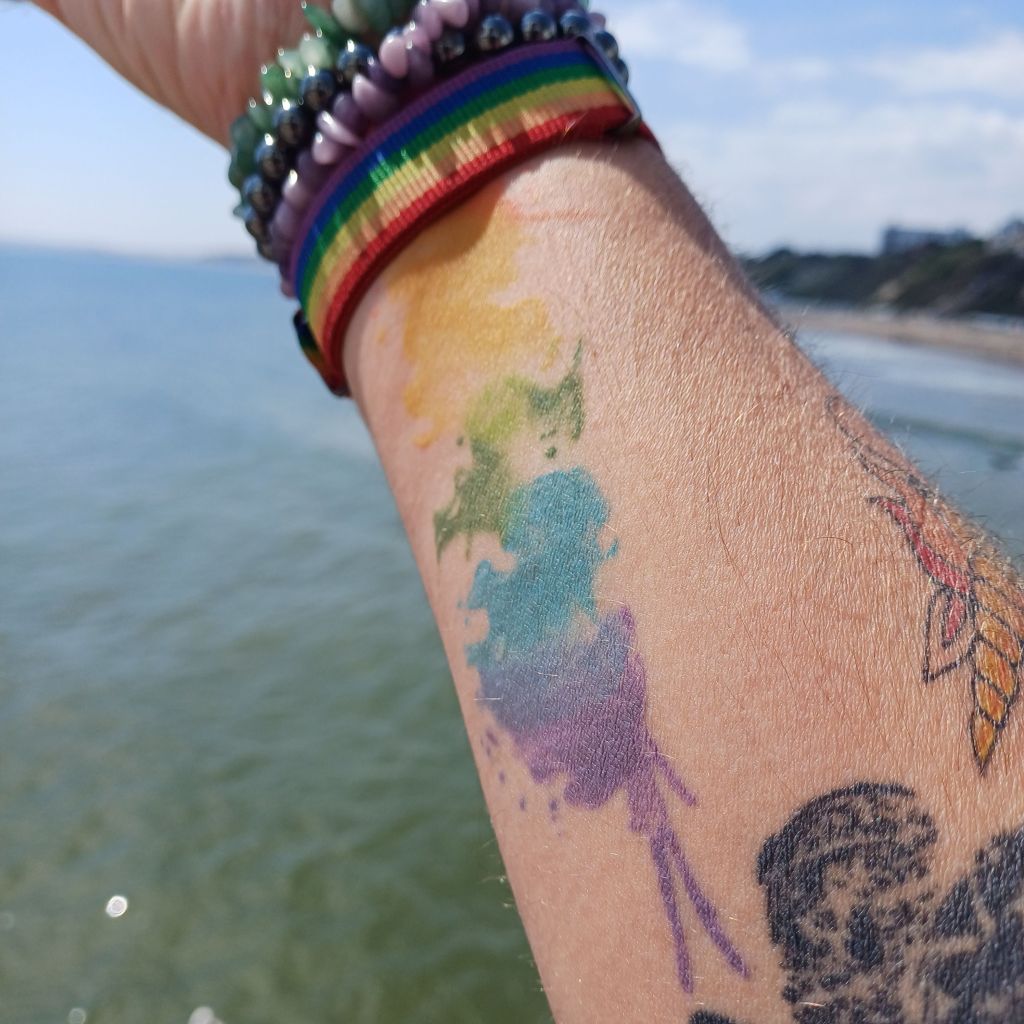
So I wear my rainbows, sometimes more discrete, sometimes as bold as the day is bright.
I stand Proud so that people who think that they don’t know any LGBTQIA+ people can say that they know at least one person – and I am just a normal human and nothing scary.
I stand Proud so that others might have the courage to be their true and authentic selves.
Pride is protective, connective, and deeply earned.
To be continued…

 Eunuchorn
Leave a comment