
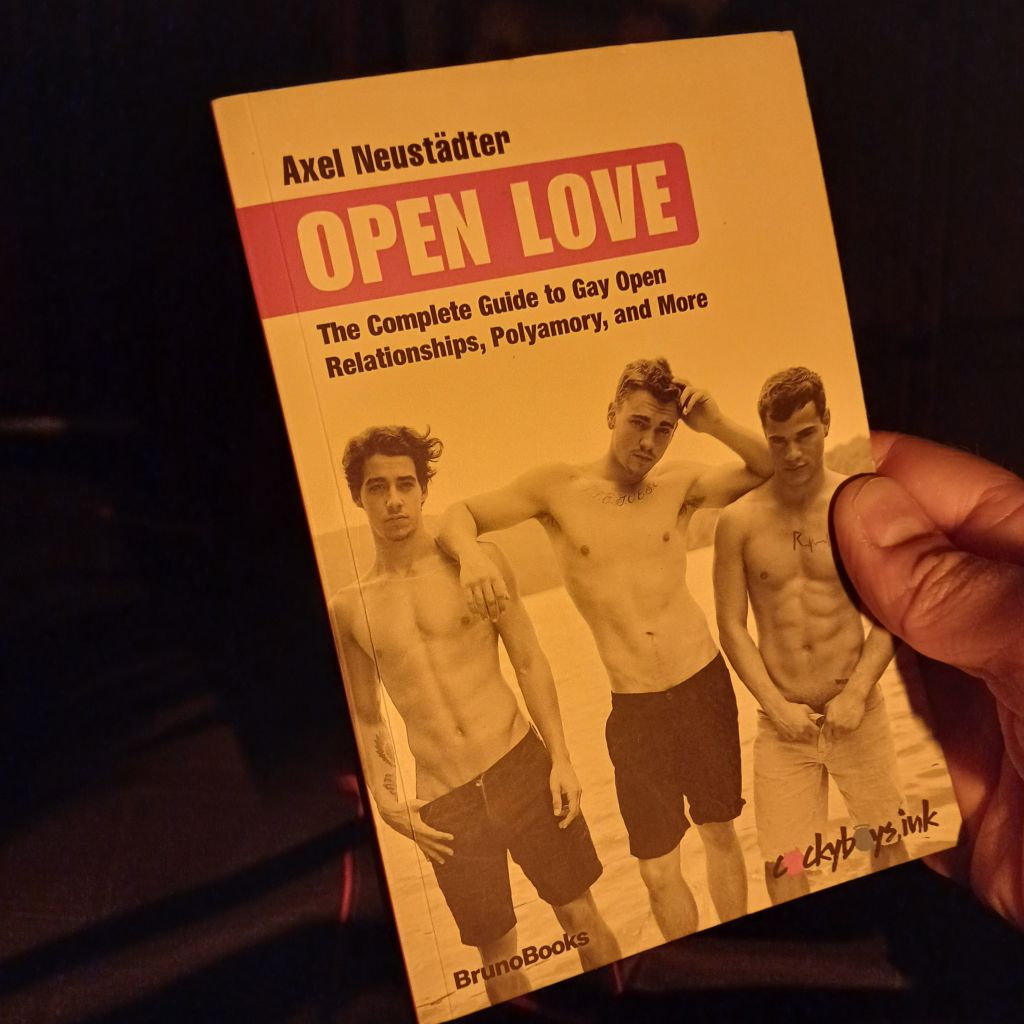
My husband bought us this book to read and work through together. We kept having the same discussion, where he reminded me that that we were only taking about opening the relationship because it was what I wanted. If he wanted it, he never said and we never got to the bottom of it.
After a few (mis)adventures, hubby decided that an open relationship wasn’t for him. Monogamy became a formal agreement between us if we were to have a relationship.
However, this book was just sat there, so I thought I would read it and see what I could learn!
Chapter 1: Status Single
In this chapter, Axel asks the reader to imagine that they are single and look at their life as though they were free of care and without any kind of history.
Do you actually want to be in a relationship?
Ye-es … but don’t think I’d want to be in another relationship if my marriage fails. I feel that there is nothing left of me that could sustain such an undertaking.
Why do you want a relationship?
It’s certainly not because I don’t want to be alone! There are increasing attractions to not sharing my life with someone else – being married is hard work!
I love sharing my time with people I care about – and my favourite person to share my time with is my husband (ok, I’ve stepped off the “pretend your single” premise of this chapter). It is true: I enjoy going places with him, we both like wandering into strange shops, or exploring an old country house, or even a ruin. When he doesn’t come with me, I look forward to telling him what it was like and sharing the experience that way.
Actually, it’s wonderful to have somebody to tell things to – shame he’s not always interested!
What do you expect from a relationship?
- Safety
- Company
- Friendship
- Fun
- Love
- Support
- Affirmation
- Happiness
- Intimacy
- Independence
Interesting that all but one of my selections came under the heading “down to earth and realistic”, with only independence falling under the “subject to negotiation”. I picked nothing from the “ambitious but unrealistic” section. I should be able to get what I want from a relationship. Why can’t I, I wonder?
Chapter 2 – Status: spoken for
The meaning of fidelity
Axel brings an interesting point to the table: what is fidelity?
He splits it into two halves. The traditional, monogamistic notion of sexual fidelity, and the idea of emotional fidelity.
But what does emotional fidelity mean? Does it mean not catching feelings for other people? Maybe it means being honest with and trusting of one’s partner?
I believe that is the latter.
it would be terribly banal for gay men to simply ape the bourgeois, heterosexual romantic ideal. Very few of them do. The struggle for gay marriage is primarily a political struggle for social equality between same sex relationships and heterosexual relationships.
Page 92
Whoops. I really did think that the heterosexual monogamous model was there only one that would work. A few things shaped this belief:
- Religious upbringing: how this maintained it’s power over me after I left the church, I do not know – deep seated inculcation I guess.
- No other models available: there simply weren’t any other models, successful or otherwise to take as templates. I suppose I lacked the courage to imagine a different way of being.
- AIDS: both my husband and I survived the AIDS crisis. Dying from AIDS was still a thing when we met, although I only know one person who died of the disease, nevertheless the trauma shaped my life and my choices. Monogamy seemed the only way not to die.
None of these are romantic reasons for being in a monogamous relationship. The final reason is, perhaps, transient: I was head over heels in love – in that state it feels like you’ve found “the one” and all other needs are forever banished.
I did realise that the roles, which can seem so rigid in some heterosexual relationships, had to be worked out from first principles. I imagine that gay liberation and female liberation must therefore go hand in hand, since if same sex unions must still fulfil all the functions of their hetero counterparts, there is scope to reimagine how a heterosexual coupling could work.
If you haven’t come to terms with being gay, you haven’t come to terms with being yourself. This will make it much harder for you to “show” your partner who you are. After all, it’s impossible for a partner to really know you if you don’t even know yourself.
Page 95
Here is the nub of why I could never tell my husband who I was and why I fought any attempt by him to find out: I rejected my inner self. Anything that might free the monster had to be put down and silenced.
Chapter 3 – Status: open
In this chapter, we’re invited to work out what it means to actually be in an open relationship. There’s a fabulous section on all the various kinds of open relationships, with special attention paid to the threesome.
Long, long ago my husband suggested a threesome. I am afraid that I refused him because I was afraid that there was a strong likelihood that he would be jealous if I didn’t balance the new comer with him – and my inability to find balance in my relationships with my friends, my interests, and my husband has been a great source of conflict between us and I didn’t fancy adding to it.
Our abortive attempt to open the relationship up recently spectacularly exploded and we are still trying to work out how the hell we can continue together. I think my fears were justified, although not for the reasons I had originally thought.
The question of whether external fuck buddies can be brought into your shared home – and if so, under what conditions – should be cleared up beforehand.
Page 142
And this is where I fell down: we hadn’t explicitly agreed on a rule about bringing people home, nevertheless, I would have felt quite uncomfortable bringing someone back to the house – this was our safe space. Yet, somebody who was already in the house I wasn’t sure what the rules were – and I forgot the cardinal rule: if in doubt, don’t!
Even on my low dose of testosterone, when it was there on a plate I couldn’t say “no”. But neither could I be dishonest – and as far as I was concerned about open relationships, being open with each other was crucial for success.
As it happened, the incident in the house and my subsequent honesty about it put an end to our open relationship experiment. At least for the moment.
Jealousy results from your own lack of self-esteem.
Page 146
I’m not sure that I experience jealousy the same way as other people. I don’t look at others and wish I had what they had. Well, maybe I wish I looked like that guy with his nature waist and broad shoulders, but that’s not really jealousy. I don’t begrudge people things. If I’m upset that billionaires gather ever more billions, it’s not because it wasn’t what they have, but because I see the poverty around me and wish that things were shared out a little more evenly.
I’ve never been jealous of my husband’s friendships. I have thought they were “a bad influence” (how patronising!) because they encouraged him to go out drinking, and when he got home then the physical and verbal abuse would begin.
I’ve never been jealous that he’s spent time with them.
Many years ago he told me that he was having an affair with somebody called “Toby”. It turned out that Toby didn’t exist and hubby was just trying to get a reaction – hubby thinks that jealousy is a good thing in a relationship because it shows you care. Or perhaps I misunderstand, because that sounds a bit shit really.
To me, jealousy just seems toxic.
The secret to polyamorous relationships: you have to be able to address your own needs with self-censorship, you have to find a way to communicate these to the people around you and you have to find a way of fulfilling them.
Page 157
Well, I screwed that one up by simply never even admitting my needs to myself, then exploding in a bewildering sequence of revelations to my husband, and even then being unable to communicate my needs clearly and kindly. I didn’t realise it at the time, but I didn’t simply express my needs, I demanded that they be satisfied – if not by him, then by somebody.
I feel that in order to get one’s needs satisfied when in any kind of relationship, the first thing is to express them in a way that doesn’t present as an ultimatum. Ultimata are just going to put your other half onto the defensive. If they refuse, then things must escalate and get out of control. If they capitulate, they have not made a free decision.
It would seem to me that polyamorism can only work where each relationship understands the boundaries and can make free and unencumbered decisions about their involvement. There can be no answer of coersion if these relationships are too be happy and successful – and fun!
… what makes the concept of monogamy so revolting is primarily the fact that it uses the scourge of morality to rob it’s adherents of their freedom to make choices for themselves.
Page 160
I am really beginning to understand and value “free choices”, by which I mean choices that we make of our own free will and not pressured into by societal expectation, or duty, – or fear.
Monogamy is a valid choice for configuring a relationship, as is polyamory – what is essential is free, considered, and unencumbered consent. This is the point of this book: negotiating how a relationship will work to the benefit of all it’s members – no matter how many people or what genders are part of the relationship.
My husband and I started to read through this book together when we first started considering the idea of opening the relationship. We couldn’t agree on how to read the book, and it finally got shelved. I should have taken that as a hint that my husband really wasn’t cool with opening the relationship – it at the very least – wasn’t really fit such a move.
I feel that this book is a useful tool for anyone, single or taken, who wishes to explore open love.

 Eunuchorn
Leave a reply to My Blogging Process: The Types of Posts I Write – Eunuchorn Cancel reply