

Continuing from:
https://eunuchorn.uk/2024/07/15/untypical-book-review-part-1/
[pathological demand avoidance] is the name we give to a set of behaviours that orbit the idea “demand”, referring to any kind of request made by someone else of the autistic person in question.
Page 104
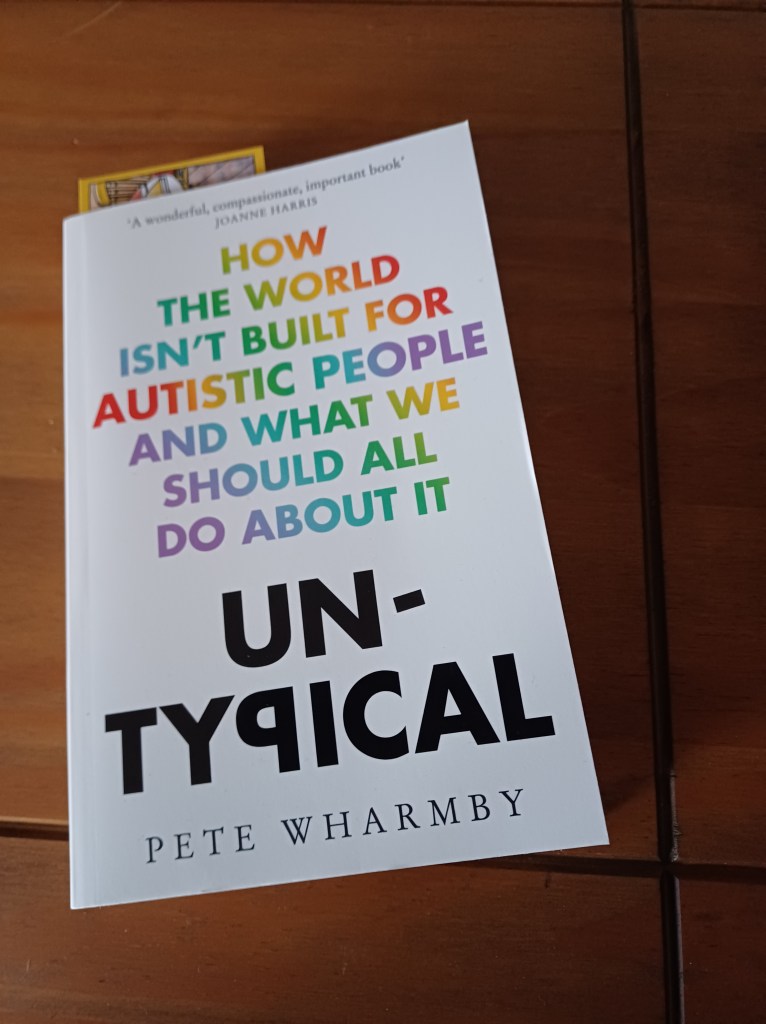
If my husband asks me to help around the house, I have to work hard to stifle the irritation – sometimes anger – at the request. He’s done nothing wrong, yet I have these feelings that I must suppress. I get on and do it, but I’ll be in a pretty shitty mood for some time afterwards, until I’ve reset the balance by spending time on my own, a bit of reading or piano practice.
It’s an irrational response that can make life unpleasant for me, and sometimes for the person who requests something from me.
The instinctive kickback can be fought and ignored, with practice, and I think that a number of adults do master this, but the internal fight remains … when I do succeed, I find that my brains “bandwidth” narrows at these times, leading to low of temper and general irritability…
Page 105
It can happen at work when I’m deep into something and somebody disturbs me with a problem that needs resolving – a wave of resentment washes over me, and my responses are likely to be quite curt and rude. I don’t take interruptions kindly!
… as I fail to cope with demands made of me and retreat further into myself…
Page 106
During those times when I am being overwhelmed by other people’s needs and requests, I need more and more quiet time – I need to retreat to regroup and get my shit in order.
When faced with a domestic crisis (for example my husband’s recent overdose and suicide attempt), I initially felt anger and resentment and my peaceful and stability bringing routines were shattered. I feel very bad that was my reaction, but that’s what it was! Once I accepted the situation and established a new routine that enabled me to fulfil these needs and balance my own peace of mind, that bad feeling went away, and I was able to refocus a little on the tasks that needed doing.
However, jumping track like that is exhausting – I slept for ten hours last night!
… being forced to socialise against their will, which will involve masking – and, as I hope you remember, forcing kids (or indeed any autistic person) to mask is, in its own way, an act of violence.
Page 139
This was something the author discussed in a section on schools. I didn’t find early school that difficult (I remember at play school that I liked to dress up as an old lady and hit other children with my handbag).
Infant school they encouraged my creativity. I had a bunch of weird friends saved we were all weird together.
Though school was different. I was a swot. I was bullied. I still had my weird friends though. The bullying worsened and became homophobic. The school did their best to help but were hobbled in their attempts by anti-gay laws at the time.
There were a few times where the bullying got to the point where I had a meltdown and lashed out.
However, I am gay – or something more complicated (what does gay mean to somebody who identifies as a middle-gender?) – there’s a term used for the masking done by LGBTQ+ people: being in the closet. I reckon that LGBTQ+ autistics are going to be bloody good at masking!
I was particularly drawn to the last part of that quote “… forcing … any autistic person … to mask is … an act of violence”. Here I am thinking of all the attempts people have made to force me to comply with their version of “normal” and how that is actually an act of rejection of my true self.
My authentic autistic self was not good enough for them.
[group work] gets much worse if the autistic child is trans or non-binary, or if they’re from an ethnic minority background, then the chance of a negative outcome rockets up … the teacher, who would normally be able to monitor for social in unpleasantness with reasonable ease, is now less able to intervene.
Page 147
I hated group work, especially in glasses that my weird friends were not in; I was guaranteed to get unpleasantly teased. I don’t know why, but teasing by girls has always been particularly unpleasant.
Back in the day, group work was mercifully rare in schools.
an autistic member of the group may misjudge things – perhaps talk to much about what they want to do or encroach unknowingly on the leader’s turf, meting out roles and tasks in a way that seems logical. Suddenly, without warning, the leader is furious and puts the autistic student in their place, perhaps by ignoring them, perhaps by insulting them, perhaps by a sophisticated melding of the two.
Page 147-8
Been there! Done that! When I’m into something and excited by it, I can really take over. It could happen as a child, and it happens as an adult. These days I am much more sensitive to the hierarchy and the problems that overstepping might bring. Maybe too sensitive, as I won’t always speak when it is needful for me to do so. I have learnt that if I need to question a leader’s decision, that is best done in private.
I hated sports … but the way we were expected to somehow understand the rules without ever having had them explained to us.
Page 150
I still hate team sports. I enjoy running ON MY OWN, cycling ON MY OWN. I hated that the other boys would exclude me from the game, as though winning was everything. This is only a PE lesson you idiots! We were expected to know how to handle a ball with our feet, to know how to pass, tackle, and intercept, to know what the fucking offside rule was all about. Football seemed designed to filter out any kid without ball skills in their DNA.
We had one teacher who would allow my weird friends and me to hide away in the squash courts. He must have known that we wouldn’t be playing squash. Mr Potter: a very kind man.
I love to run now, but really? Cross country running as a one off? To run distance requires a training plan and gradual increments of distance and intensity. You cannot just take a kid who has never run and have them run 5km without any kind of lead up to it – that’s true whether the kids is autistic or not!
Since school, I have learnt to enjoy running … especially cross country. Given my experience at school, it’s a surprise that I didn’t become a complete couch potato.
I’ve always been terrified of being criticised
Page 178
I would never have considered “Rejection Sensitivity Dysphoria” (a strong emotional reaction to negative feedback or criticism) as being a feature on autism – realising that it has is part in it gives me better understanding of why rejection has such a strong effect on me!
I could not understand it: my mum and nan gave me unconditional love (my dad I thought hated me until I heard through the grapevine how proud he was of my going to uni). When I came out as gay, mum was so loving, my brother was wonderful. I didn’t tell my nan for a few years, but she was lovely. Even my dad, well, he didn’t react very much at all. My best friend let me down, but he was just one person, university I had support from a wonderful lecturer whom I’ve written off in the past. My first job I made a big announcement that I was gay and if they had a problem with it, then that was their problem.
I have had a few homophobic incidents. I got roughed up once by some straight mates of a barman I fancied. And there’s been homophobic abuse shouted at me.
So where did I get that fear of rejection from? I suppose one could say that my husband not accepting my quirky ways was a rejection (much was I rejected those aspects of him that I found difficult).
It makes sense if it’s just baked into my being.
Many autistic people struggle to retain verbal information
Page 189
This makes absolute sense! It’s a common complaint from my husband, wanted something that I can identify with my work: if I don’t write it down, I forget it. Knowing that this can be a feature of the condition enables me to fully accept that this is part of me. I know that I must message notes as soon after the conversation as humanly possible, else the conversation might as well not take place!
… we don’t seem to care very much for arbitrary ideas. I think it is fair to say that many autistic people see authority as something that has truly got to be earned
Page 193
If I encounter a rule that I don’t understand and hasn’t been explained to me, I am quite likely to just ignore it. It can make me seem either as “entitled” or as a rebel. I’m not really brave enough to be a proper rebel.
However, I believe passionately in abstract concepts like democracy, self-determination, and freedom from fear.
… my brain is like a busy apartment block where everybody is loud and noisy and horrible, and ask the walls are thin plaster. All the little nooks and crannies of my mind are assaulted by an endless dirge of noise and activity …
Page 189
Hell yeah! I almost always have some music or other playing. I’ll be noticing random details, counting things, making connections – all of which gets forgotten almost as soon as it’s noted.
Voice conversations can be difficult for the reason, text conversations don’t seem to have quite the same problem.
The music and noise get much quieter or disappears completely when I’m focusing on something – whether playing the piano, drawing, writing, or reading.
Talking only shuts up the music if the conversation grabs me to the extent that nobody else can get a word in!
I find that when my stress levels reach a particular point, my voice begins to falter as a tool, becoming less reliable and less focused, and I begin to lose my vocabulary and grammar.
Page 239
Here the author is describing the early stages of shutdown – it’s as though he were in my own body and head.
There’s a huge cross over between the autistic and trans communities. … I’m inclined to agree with the idea that it’s a result of the autistic people feeling less bound by the established rules of society and more likely to go with what fits them and damned the expectations of the neuro-majority.
Page 240
Here I am! A non-binary gay eunuch, enjoying questioning everything about fever and sexuality and all the assumptions that have ever been put on me and forced me into a box that just isn’t right for me!
Remember that as many as one in twenty people may be autistic and it’s possible that one in five are neuro-divergent in some way.
Page 242
There are so many people who have learnt to hide their true self from the world and face the everyday energy drain that zaps the very life from us.
This book gave me an insight into the brain of somebody like me: you cannot easily tell how somebody else experiences the world just by looking at them.
This is a book that has opened my eyes up to myself and to a portion of the population that I have felt a strange affinity to buy had never been able to put my finger on why I felt that way. Perhaps now I know.
My belief is that this book is changing my life.
To quote a friend, this book is
a Rosetta Stone for your own neuropath
Thank you for believing and validating my experience, my friend!

 Eunuchorn
Leave a comment