

I was in Bath with a friend when I saw this book. It was on a stand as I entered the shop and again I saw it as I was leaving – of course, the bright simple writing on the cover grabbed me first – but the title was key. My nephew is autistic. My younger brother is watching his son develop and is realising that most likely he is also. My brother and I believe that our father is probably autistic. I have several autistic friends. So I bought the book thinking that I would gain insight and understanding into my friends and family.
Then …
WHACK!
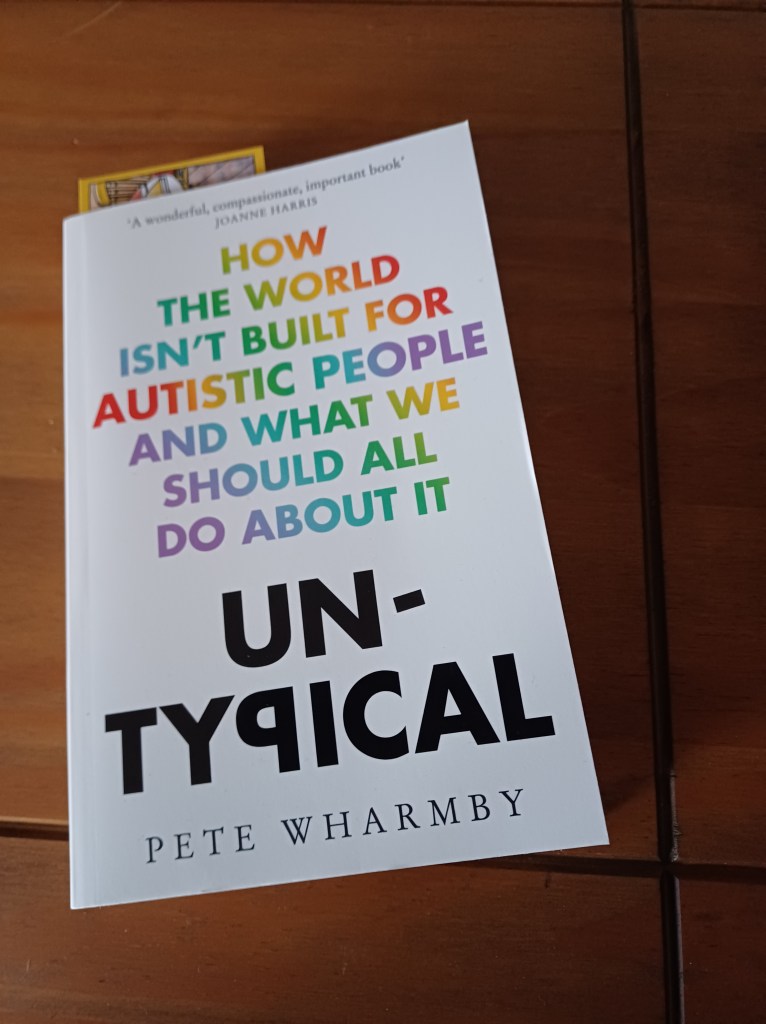
Part of the way through the book I realise that this book is about me and my life and my symptoms. I have never in all my years experienced such a feeling with a book.
As usual, I have jotted down various little extracts and have given some thought to each of them and how they relate to me, or what I can learn from them … here goes …
(of conversation) … I have no idea when it’s my own turn, and so I often find myself sitting very quietly, intensely waiting for a pause long enough for me represent an unambiguous jumping off point.
Page 23
This was my first point of identification, after reading twenty-three pages of interesting but unremarkable text: I do struggle to know when it’s my turn to speak. Sometimes, I’ll inadvertently talk over somebody (my husband will crossly say “I hadn’t finished talking”), at other times I am sat there wondering whether that inhalation, that pause for breath, is my queue to speak. I lose my place, they say too much, and then the moment has passed and we are on to the next topic.
Sometimes, when I have got my window into the conversation, I’ll rattle on and not take a breath myself – not realising or considering that there may be others who might want to get a word in.
It always feels to me that the neuro-typical world puts arbitrary limits on how passionate one is ‘allowed’ to be about a subject.
Page 25
I really have learnt not to say very much about my interests, whether its piano, or history, or Star Wars or Star Trek – I don’t even start these days.
We learn to adopt a kind of persona – based on all the things our extremely observant brains have noticed in other people – in order to please those around us so they stop bullying us or causing us harm. … this is first and foremost a trauma response.
Page 30
I think I adopted a lot of my mum’s characteristics of being agreeable (not bad attributes to adopt) because she was universally loved and had many friends (I also picked up some of her flaws). I have also picked up some characteristics from my father, and you will remember from the intro that my brother and I believe that he’s neuro-divergent – however, he has many friends and is popular within his circle. He was just a bit shit with his family – I hope that I can be more compassionate towards him.
Autistic people frequently report using elements of personalities they observe – a friend, perhaps, or even a favourite fictional character – as building blocks for their mask, almost as if we’re constructing then out of Lego bricks
Page 31
This begins to get a little bit interesting: I modelled my persona on Mr Spock and Commander Data – both characters with controlled or completely absent emotions. I have felt a lot of fear around my emotions – especially anger and frustration and fear; I have tried to suppress those feelings, not that I am particularly skilled at identifying them. As a result, they act without my knowledge, and I hurt my loved ones – especially my husband.
There’s a … type of meltdown … this we call “shutdown”. It’s a much more passive and less aggressive form of break, where the autistic person reaches something approaching a state of catatonia for a short period in response to continued exposure to intolerable stress. It can involve a total loss of all communication, as well as an inability to move out even think.
Page 40
And this was the moment.
This was the moment in the book where I felt like I had been smacked around the head with a bag of bricks.
This is me.
So many times, more times than I can remember, I have frozen in moments of crisis – of emotional overwhelm, when the words and the feelings come at me like an unending volley of cannon fire. My processing fails to keep up with the torrent of words and the feelings being expressed by the speaker, and the emotions that I myself am feeling. The gears in my brain seize up and I can lose the ability to speak. I cannot move. I am literally frozen, as my consciousness disappears inside me, going from frantic to god-only-knows-where.
I cannot move until the perceived threat has gone. I may not be able to speak even then, or I may regain some speech before I move.
Actually, while I am in that state, I feel as though I am being assaulted.
Too often, non-autistic people are too busy criticising or punishing the autistic person for whatever perceived terrible behaviour they have shown in the early stages of meltdown … so often autistic people are followed from room to room as they try to escape the stressor … and they are shouted at and challenged.
Page 41
When my husband is having his own bipolar/PTSD episode, he would follow me around – while I was still able to move. Sometimes he would come up to the bedroom and start at me while I was asleep. At those times I would wake up shutdown!
I have smashed plates and cups in frustration, but worse, I have said so many hurtful things trying to make the assault stop. To many of them got home and further damaged an already hurting man.
I have gotten into so much trouble with my husband for trying to shut down conversations or flee from the situation. I understand his frustration, that he cannot say what he needs to say without the risk of me shutting down or going into a meltdown. It has reached the stage where he cannot even start a conversation. He has to run through a check list to make sure that all my primary needs are met (food, drink, sleep, not stressed over something else), that it doesn’t leave much opportunity for conversation.
The net result of my emotional instability is that my husband feels silenced and unheard and unimportant.
I hope that with a diagnosis and a change in strategy, that we can have the conversations we need to have without meltdowns or shutdowns.
On the phone, the conversation I try to focus on is interrupted and blanketed by of hisses and blips and pops, and tinny echoes of electronic communication. With all this chaos in the background, I’ve no chance of fully processing everything that’s said.
Page 45
This isn’t quite what happens for me, it’s more that the chaos in my brain is playing music and I’m getting distracted by things I need to do: it is impossible to focus. I can only hope that I’m saying “yes” or “no” at the right times. Often, I need to ask the person to repeat what they’ve just said.
I’m thinking about telephone calls a little more; the neuro-typical at the other end cannot see my body language, they won’t know that I’m bored or want to speak or that I’m simply not getting what they’re saying – that their pace of speaking is faster than I can assimilate the information. This is particularly true if this is an emotionally difficult conversation, however it can even happen in conversations that really grab my attention!
Conversely, if I’m on a subject that interests me, the person at the other end can go and make a cup of tea and have a nap before I realise they’re gone.
Some autistic people are, in many relevant ways, fairly extroverted. By this I mean that they thrive on being with people and gaining attention (with the autistic provision that they get downtime too) in a way that most non-autistic people may not expect.
Page 62
This was a suprise to me; I had previously thought that I couldn’t be autistic since I can do chitchat and socialisation in small doses and enjoy it. Learning that there are some who enjoy being around people was a revelation. It was also instructional, that they use up their social batteries much more quickly that neuro-typical counterparts – sometimes needing to flee the gathering with little or no notice. That’s me! I can be the life and soul for a while and then quite suddenly I am done and have to get away. At other times, I’m just happy to be there and will watch the conversation, joining in only very occasionally. I think that whichever version of me is present at the event, the length of time I’m sure to stay there and feel comfortable is approximately two hours.
[autistic people] may seem to tire more easily, rather abruptly shifting from being a core part of the social experience … to being distant and detached
Page 73
And there we have it: exactly my experience!
My husband brings up the time we had in Nepal trekking with a group of complete strangers as a reason why I cannot be autistic: I talked with most of them on and off and didn’t give him much of a chance to get a word in! There are a few things about this situation that I now understand: firstly, I was hyper-simulated; secondly, on the trek there was plenty of opportunity to have quiet time with nature, which I find enormously restoring. I could be with somebody for thirty minutes or an hour, then I could slip behind the group and just be by myself for a while. It was the perfect setup for me to socialise.
I spend much of my day on Twitter, using social media to socialise … I’ve no idea why this is viewed so disparagingly but it’s obvious that the majority of people see this kind of online relationship as a pair imitation of the real thing
Page 70
In the last year, I have really expanded my social media activity. In doing so I have uncovered a whole world of support and community for myself. The online community helped me come to terms with who I am and what I needed. I have found identification with so many people and I try to pass on the love and support that I found.
Some of these contacts are just for the duration of the conversation; but they can still have value and meaning. Others were with me for a while and helped significantly. There are many with whom I have become very good friends and I value them and love them dearly – even though many of them live several timezones away from me. A couple I have met in person.
My husband can’t see that these relationships are nevertheless friendships. For him, a friend is somebody you see and can talk to. I would love to meet more of these online friends, but just because I never met them doesn’t diminish their importance to me.
… the traditional doesn’t doesn’t really hold much meaning for us autistic folks, and as such we might prefer things that are decidedly non-traditional and be perfectly at peace with this side of ourselves. We know that the autistic population has strong ties to the LGBTQ+ community, with an emphasis on the TQ+, and I believe that this is because of our distain for “norms” means we’re more able to exist the way we should exist, life the lives we ought to live … another example is the number of polyamorous autistic people …
Page 77
So here I now find myself: living my authentic life as a non-binary eunuch! Whilst eunuchs just be amongst the oldest of body-modifications and the oldest gender-transition, it’s not really something that is seen much in the modern western world – and I love that! I love that I break the mould and work out my own rules for life!
… a recognition of the patterns and actions in life that lead to the best outcomes, and an earnest desire to repeat them … we seek to replicate success when we experience it.
Page 97
This quote is from a section on “~stitions” (like superstitions, but more based on experience). The author reflected that they tend to repeat behaviour and actions that have been associated with a happy outcome in the past, and avoid those associated with bad outcomes. Initially, I wasn’t sure whether I related so much to that view: I don’t walk particular routes because the rest of the day worked out fine the last time I walked it, or buy a certain brand of cheese because it’s associated with some happy turn of events that I wish to replicate.
However, I am aware that I have my own internal checklist of when it is safe to start a conversation which might get heavy, making sure that all my primary needs are met, shutting down all external distractions, checking in on my mood, selecting a particular day of the week (Saturday or Sunday during the day), and so on. I avoid like the plague situations that have worked out most badly and still not to replicate those setups. Thing is, these all seem rational, if perhaps excessive and constraining prerequisites to a conversation.
No wonder my husband feels so imprisoned by my requirements before we can talk.
Oh yes, I need at least twenty-four hours’ notice before we can talk … and all those other things also need to be true.
This is a BIG post, to be continued! … read the rest here!

 Eunuchorn
Leave a reply to Unmasking Autism (book review) – Part 3 – Eunuchorn Cancel reply