
While reading 50 LGBTQ+ Finds, I discovered that Woden – king of the Anglo-Saxon gods – was a gender-bending deity! So I thought I’d do a bit of research…
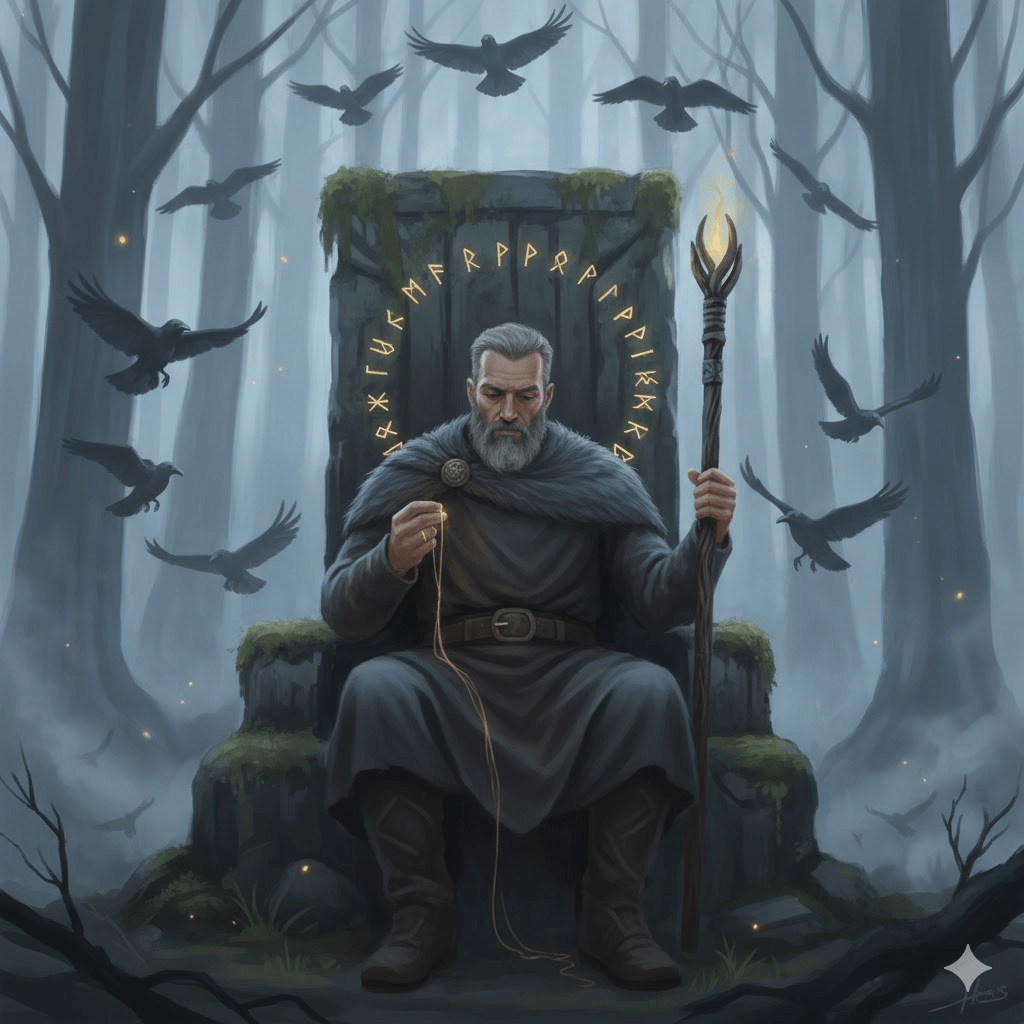
The image of Woden – or Odin, if you prefer his northern form – is usually painted in deep, masculine tones. The one-eyed god of war and wisdom, rider of storms, wanderer in the wilderness. His worshippers imagined him cloaked in ravens and shadow, dispensing victory to kings and death to the fallen. And yet, within that severe mythology, there’s a thread of something distinctly feminine – and to the Anglo-Saxons and Norse alike, that was both dangerous and divine.
Woden was a practitioner of seiðr: a form of magic that blurred the line between prophecy, enchantment, and manipulation of fate itself. It was the magic of women – of the völur, the seeresses who chanted and wove destinies in trance. For a man to practise seiðr was to cross a line. The Ynglinga saga calls it “ergi” – unmanliness, a shameful inversion of gendered roles. Yet Woden did it anyway. The All-Father, lord of warriors, submitted himself to a craft of women, and through it gained mastery of the hidden threads that bind the world.
This was not mere hypocrisy; it was liminality. Woden lived between states – life and death, human and divine, male and female. He was a god of thresholds, forever shifting form: a wolf among men, a serpent in the underworld, a beggar on the road. His wisdom came not from dominance but from transgression. Where Thor embodied strength and simplicity, Woden’s power came from surrender, trickery, and ecstatic transformation.
To the Norse mind, this was both awe-inspiring and unsettling. The sagas call Odin “seiðmaðr mikill” – a great worker of magic – but they also whisper that such arts “unman” him. To wield feminine power was to risk losing one’s place in the hierarchy of men. Yet Odin seemed to thrive in that ambiguity. Perhaps that was the point: to show that true power required stepping beyond the rigid confines of gendered virtue. That even the mightiest god must kneel before the mysteries of the feminine if he wished to command fate.
Compare him to the other high gods of Indo-European pantheons and the contrast becomes clear. Zeus and Jupiter ruled by thunder and decree; Apollo through intellect and order; Ares through brute violence. Woden’s dominion, by contrast, was shrouded and strange. His wisdom was won through ordeal, self-sacrifice, and a willingness to embody the Other. He hanged himself upon the world-tree, pierced by his own spear – a ritual death echoing the feminine mysteries of fertility and rebirth. He didn’t merely conquer knowledge; he bled for it.
For the Anglo-Saxons, who saw Woden as both ancestral and divine, this must have been a deeply ambivalent inheritance. On one hand, he was the model of kingship and sovereignty. On the other, he represented something transgressive – the willingness to embrace that which society called taboo. To commune with spirits, to speak in riddles, to blur the lines that kept men and women, life and death, separate.
In that sense, Woden’s magic was never simply “feminine” or “masculine”. It was a revelation of how unstable those categories really were. His mastery came not from choosing one side, but from weaving between them. The same god who inspired battle frenzy could slip into a woman’s garb and chant over the cauldron. The same voice that commanded kings whispered in tongues learned from witches.
It’s almost strange to observe that Woden has no links to castration or eunuchs – despite inhabiting the border-land between male and female. Unlike a eunuch, Woden doesn’t lose fertility – but for him fertility was never carnal. He didn’t spill seed but breath, didn’t sire bodies but words. The runes were his children, the dead his lovers, the wind his voice. To the Anglo-Saxons, that must have seemed uncanny: a god who made life not with the body, but with the will.
Maybe that’s why he still haunts us. In every culture that reveres certainty, Woden stands as a reminder that wisdom often wears a disguise – and that sometimes, to know the truth, a man must risk being called unmanly.
 Eunuchorn
Leave a comment