
Spoiler Alert!
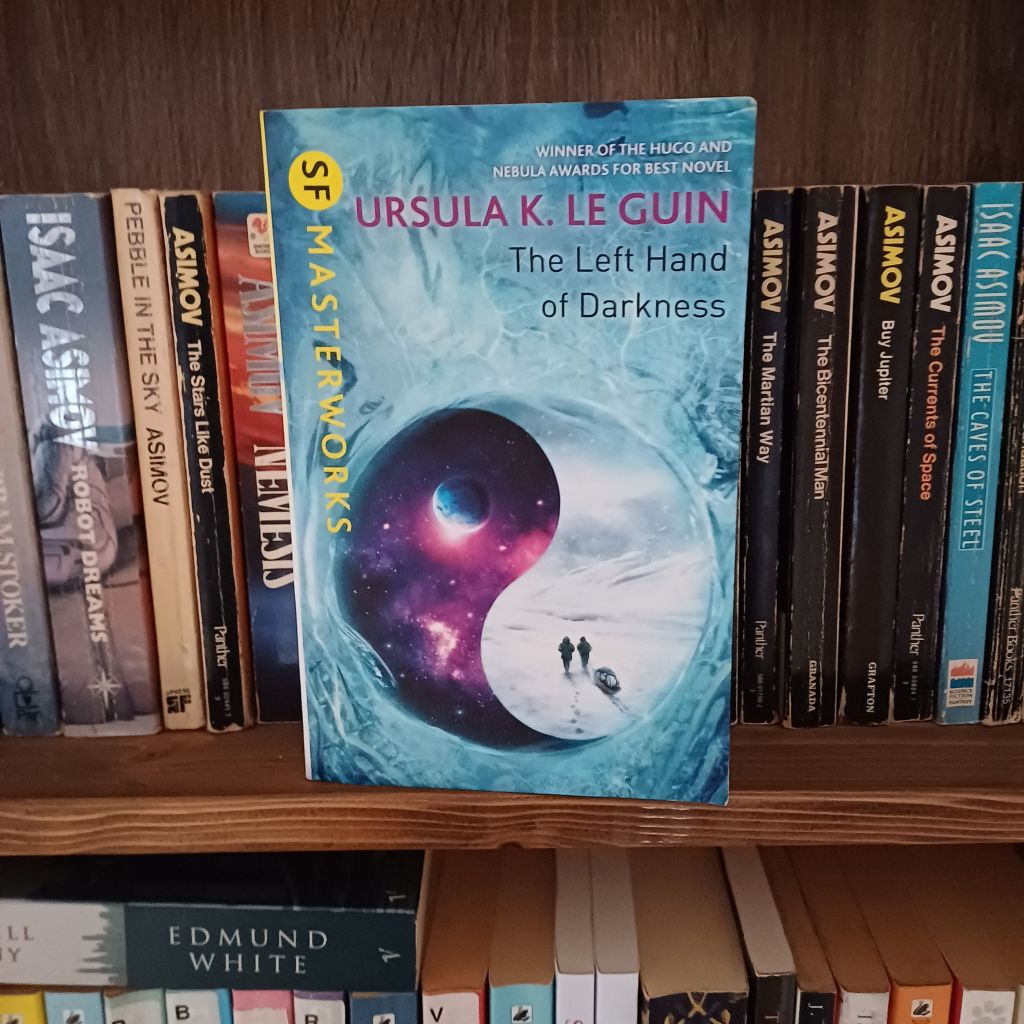
I don’t recall how I discovered this book, but I was drawn to it as a science fiction story set on a world where there are neither men nor women, yet the population is human nonetheless – agender or non-binary, except when they are “in season” (“kemmer” in the book).
Like all good science fiction, this book is a kind of thought experiment considering what a world without gender might be like. Le Guin seemed to think that there would be less conflict, more emotion, and less progressive energy. In her way, she fell into the gender trap of assuming that conflict and progress are “masculine” traits, whereas emotion and nurturing are “female” traits. However, I’m not inclined to be too harsh with her: this is a unique book tackling an otherwise unconsidered idea. I do not know whether any other science fiction of fantasy story has approached this subject.
In the foreward, Le Guin says that if she wrote this book today (it was first published in 1969), that she would have used gender-neutral pronouns, acknowledging that language and understanding changes with time. I believe that had she done so, the one twist in the book would have been perceived from the offset. At least (if you don’t read reviews or the foreward) the revelation that the citizens of this world are agender is hidden for a couple of chapters.
I don’t mean love, when I say patriotism. I mean fear. And it’s expressions are political not poetical: hate, rivalry, aggression.
Page 18
When I think about it, much of what “patriotism” is is fear based: fear of the “others”: other nations, other cultures, other religions, other people who are not like “us”.
In Le Guin’s world, aggression is rare, as is murder, so patriotism is different.
Cultural shock was nothing much compared to the biological shock I suffered as a human male among human beings who were, five-sixths of the time, hermaphroditic neuters.
Page 48
The book is written from the point of view of two individuals. A visitor (the “envoy” from the rest of humanity), and a native of this world. Their slow acceptance and gradual love of each other, although never romantic or sexual, as they travel from one political entity to another forms the spine of the story.
Travel between the various worlds of humanity takes a very long time. Communication, once established, is immediate – both these things are conceivable. It does mean that there was no way for the “envoy” to know anything about the unique biology of the people of this world before he arrived.
at last I accepted him as he was. Until then I had rejected him, refused acceptance of his own reality.
Page 248
The “envoy” struggled to accept the difference between the people of this world and the rest of humanity. That tension is a bit heartbreaking – though necessary for the narrative to land, it reminds me how even in fiction, our discomfort with difference runs deep. I would hope that in the far future that sex, gender, and sexuality, in all of their magical sand infinite varieties, are as remarkable as hair colour – and just as relevant.
A profound love between two people involves, after all, the power and chance of doing profound hurt.
Page 249
I found this insight profound and it struck a chord with me, especially given the trouble in my own marriage.
The Left Hand Of Darkness is well written and enjoyable, sadly, knowing what is about rather spoils the revelation. That doesn’t change the slow discovery of shared humanity beyond the different biology.
I’m going to see what else Le Guin has written: I am curious what other world and thought experiments she conducts!

 Eunuchorn
Leave a comment