
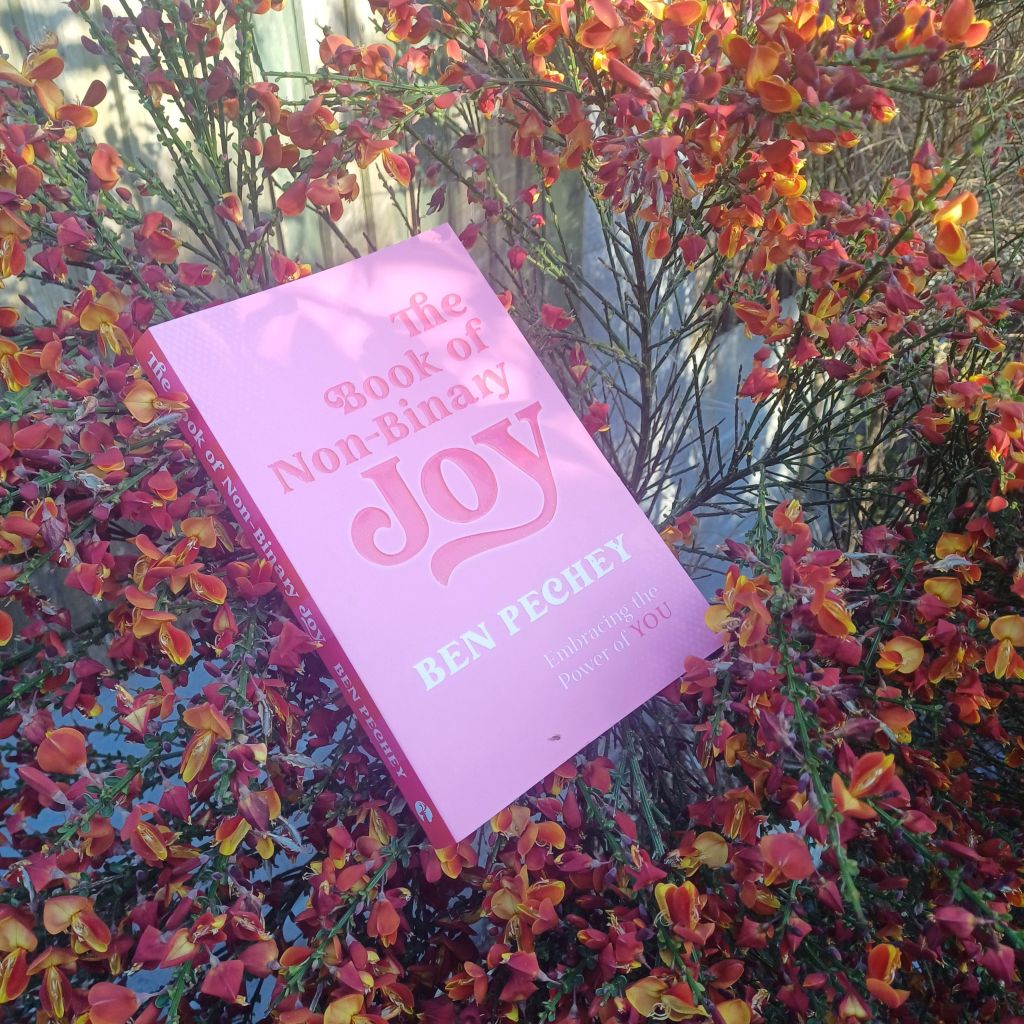
Oh hello darling, and welcome to this, my very first book.
Thus the Introduction begins, with warmth and humour: I am going to enjoy reading this book!
And so they continue, in their chatty, familiar, humourous – if perhaps a little campy – way. The writing style is easy, so easy, and like a can of Pringles, once you pop…
Chapter 1: Who are you?
…I behaved well enough to be placed in a class with children less likely to bully me.
Page 17
This got me very early on in the chapter. One of the reasons that I was a good student at school was to avoid the bullies, who could be horrific. I didn’t realise that this escape route was used by others.
Pechey moves on to describe their terms. I keep itching to pin them down to male or female … interesting, since I also claim non-binary and prefer gender neutral terms a lot of the time; I’m thinking that if I have this pull, it’s not unreasonable to imagine that others might as well.
A key message that Pechey is trying to convey is that how they, you, and me define ourselves is our business.
Put simply, seeing a world beyond binaries is one of the just freeing things because it removes any preordained decisions or expectations from your life.
Page 21
As I’ve come to realise – and I often say now – gender is a lie: a social construct designed to control and contain individuality and expression and enforce conformity. It’s like the assumption that precludes making choices, instead shutting down options to simplify reality to a point where it is more digestible to some, but not necessarily more accurate.
…we are the most authentic we can be because we have transcended the restraints of binary gender.
Page 22
Remember, we – none of us – were given any choices in the gender we were assigned at birth. When the midwife held the mewling babe aloft and proclaimed “it is a girl/boy*” (*delete one as applicable), a destiny was selected for us. We were not consulted. There is no option for review or revision. There is certainly no nuance that the lived experience should demand.
All of which leads onto…
Chapter 2: the obsession with gender
So, as much as your gender identity is important to who you are, it will never be as important as it is to strangers who are threatened and fascinated by you.
Page 33
In that little sentence, Pechey sounds up a lot of Judith Butler’s impenetrable text: our gender identity is more important to those who persecute us that it is to we ourselves. Butler, of course, goes on to analyse the motives of the persecution and why it is important to those who would deny us.
That is not Pechey’s aim, which is to bring joy into our lives, although there is some digging – even acknowledgement – that we all categorise people to help quickly interpret the world.
I’m forced to think back to my writings on Chapter 1 where I was trying to put Pechey into a gendered box! I can only laugh at myself and accept my humanity and try to stop doing it.
We are given an unfair disadvantage in life because currently we are being talked about and not being talked to.
Page 41
I hear this from so many trans groups: nobody writing in the media about trans issues is trans, nobody legislating on trans issues is trans. There is no representation and there are no consequences for lack of representation or requirements that trans people are represented.
It is the same for non-binary people.
Chapter 4: We’re an unfinished novel
Important terms like “microagression” and “gaslighting” are explained in easy to digest language. In fact, I think that this book serves as a useful and accessible introduction to many of the difficult subjects that I’ve read about, such as “stigma” and other works on “gender”.
The chapter also encourages people to pick their battles, pointing out that homelessness in the LGBTQIA+ community makes a massive chunk of homeless people (25% of all homeless people are from the queer community). I agree that as individuals we need to be pragmatic about our own safety.
…there is a need for digital communities too create safe spaces for people to access when they need – whether this be content, helplines, friendship groups, books like this and so many more.
Page 64
This book was written before the current changes in legislation that required age verification and before the much more intense persecution of trans and non-binary people.
There are fewer in-person safe spaces, and digital safe spaces have been closed, reduced their scope, or become inaccessible. This is not fair and I am certain it’s causing a lot of suffering. I’m pretty privileged and I’m suffering because of these changes: there are many less fortunate than I am.
Chapter 5 – What’s your pleasure?
Apparently, the books first puzzle! Being ill at the time, I decided to do the wordsearch in my head. It killed a bit of time.
Chapter 6 – Self-awareness
One of the things people reach out to me about is whether they are non-binary enough. I will say this time and again – there is no fixed way to be non-binary. That is why we are so so magical.
Page 84
This is an important message. The wonderful thing of a non-binary identity is that it rejects the notion of binary conformity. Wear what colours work for you. Wear what clothes please you. Wear (or not) what make-up makes you feel good. Style your hair in ways that makes you feel right.
[on focusing on yourself] Spoiler alert – this is how some of the most privileged people in the world live! Seriously, the mega rich cause the most damage to this world and don’t have to think about it. Yet if I dare to pop into the Co-op in a heel, suddenly I am causing a commotion.
Page 87
In the past, it was accepted that eccentricity was permitted for the elite – it still is, except that now this eccentricity is almost sociopathic.
Chapter 7 – you are privileged
Many cisgender people don’t know who they are … Suddenly seeing non-binary people using compassionate reasoning to determine their own identity could make a cisgender person nervous, because they never felt such a strong sense of self, and they suddenly feel very threatened!
Page 105
This certainly won’t apply to all cis people (and Pechey acknowledges that), but it’s a keen insight. Having an opportunity to really think about who I am and how I want to relate to the world is a privilege.
It’s certainly not something that is available to everybody on the planet. Even where such a thing is possible, most cis people won’t take the time to consider what their gender means to them.
Maybe it gives a compassionate insight into the TERFs and GERMs that are raining in our parade at the moment.
Being visible in society is one of the most basic, but powerful, ways to validate other people’s feelings.
Page 109
And this is why I try to be visible as much as I can. There might be somebody else who is in afraid to be their true self who might take some courage from what I write, the clothes I wear, and the things I do.
Chapter 8 – let’s talk about fashion
Clothes are literally pieces of fabric
Page 114
So obvious. So true. Pechey did a wonderful job of saying “dress in a way that makes you feel good”.
I enjoy wearing kilts and intend to get some more in different styles and colours. I wish have a skirt on order. But I ain’t gonna shave my legs! I like my hairy legs! But kilts makes me feel good – powerful was the word I used, but confident is probably a better word for his I felt.
Chapter 9 – self-expression
“You’re so brave”
Page 132
Pechey explains that this isn’t actually a complement, but somebody trying to “other” you.
I’m reminded of something from Yes, Minister
“Controversial” only means “this will lose you votes”. “Courageous” means “this will lose you the election”!
Yes, Minister, “The Right to Know”
I’ve included this little snippet from the timelessly hilarious and frighteningly accurate TV sitcom from there 1980s because it fully illustrates how something that sounds great is actually a sinister method of control.
It is possible that somebody saying something like “you’re so brave” is genuinely admiring you and is envious of your apparent (if not actual) confidence, but it might equally be a subtle way to undermine confidence.
Chapter 10 – Connections and allyship
It seems that while Pechey was writing this section, that the High Court made their judgement on transgender access to same sex only spaces and fucked all our lives over, making things much more dangerous for those that do need to use a space that is designated differently, from the gender they were assigned at birth.
On this chapter, there is a list of cisgender celebrities who were outspoken on queer and trans rights – it was refreshing to see such a list contain a lot of names I knew, among them people whom I didn’t know were allies, such as Alison Hammond and Nigella Lawson. I’m going to have to read more on these two.
Chapter 13 – distractions
This chapter deals with various ways to deal with the trials of day to day living. The best advice?
Listen to ABBA.
I am 100% onboard with this little snippet of advice!
Chapter 14 – resources
This chapter lists some of Pechey’s favourite Instagram content creators and a number of resources to help cope with mental health issues.
Conclusion
I thoroughly enjoyed this book. Pechey has a wonderfully accessible way of writing that reads like you are sat with an eccentric aunt dispensing her advice over a tall G&T.
The focus is on finding joy in the non-binary existence, yet I feel that the book is accessible and relevant enough to be part of anybody’s library of “books to make you feel better about yourself”.


 Eunuchorn
Leave a comment