
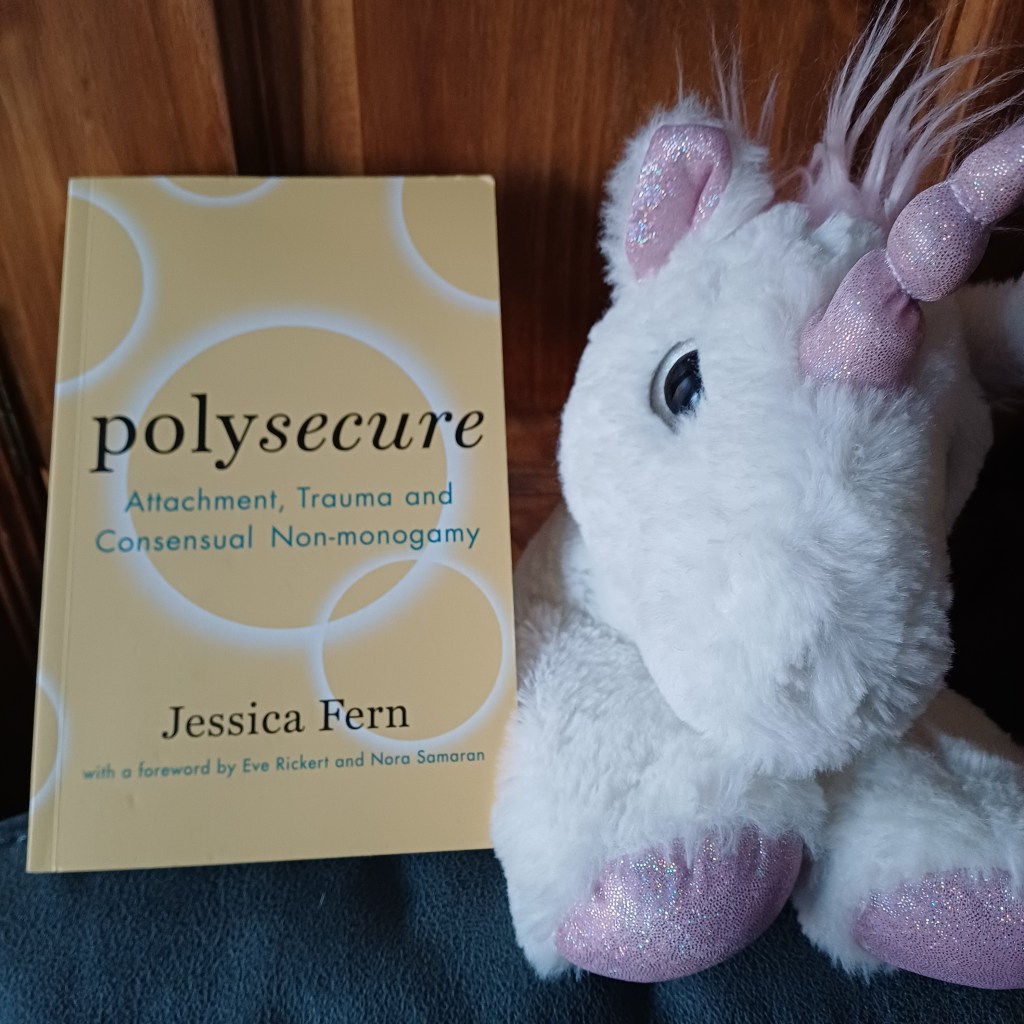
Part 1 of 4 in a short series reflecting on Polysecure by Jessica Fern
Attachment, trauma and consensual non-monogamy
My counsellor, Richard, often refers to attachment theory when we talk about my relationships – my husband, my friends and lovers, my family – and the problems that arise within them. I realised I didn’t really understand the theory, so I thought I’d learn more.
I have found that I much prefer being around people with secure attachment styles. They tend to have good boundaries and communicate more clearly.
“People with secure attachment styles are able to internalise their partners’ love and carry it with them even when they are physically separate, emotionally disconnected or in conflict.”
(p.22)
I have heard myself described as having an earned secure attachment style – one of the reasons I bought this book in the first place:
“Attachment styles are not static… you can still go on to have healthy securely attached adult relationships… experiencing what is called an earned secure attachment.”
(p.25)
That idea felt hopeful. Reassuring, even.
But then things started to wobble.
“People with the dismissive attachment style will also tend to be highly linear and logical…”
(p.33)
Shortly after:
“I frequently don’t know what I’m feeling or needing…”
“During disagreements… I tend to withdraw, shut down, or stonewall.”
(p.35)
Both of these are true for me.
I do find it very hard to identify what I’m feeling. Some emotions blur together – anger, aggression, assertiveness; hunger and anxiety. And when I am overwhelmed, I shut down.
But here’s the problem.
Those are also traits commonly associated with neurodivergence.
So how do you tell the difference?
Does one preclude the other? Or are we trying to force two overlapping models onto the same experience? It makes the whole thing feel… subjective. A bit slippery.
In my experience, neurodivergent people are also more likely to have non-conventional genders, sexualities, and relationship structures. That complicates things even further.
Are neurodivergent attachment styles properly understood?
Or are we quietly measuring neurodivergent people against neurotypical expectations and calling the mismatch “insecurity”?
Maybe what gets labelled as “insecure” is sometimes just… adaptation.
As I read on, I began to recognise my husband’s behaviour more than my own. I found myself wondering:
Was what I experienced from him jealousy… or fear of abandonment?
And then, underneath that, something older.
I began to recognise the damage done to me – by school bullying, and by the teachings of the church. Not dramatic in isolation, perhaps, but cumulative. Quiet, shaping forces.
So before I can even answer what my attachment style is…
I find myself asking whether I’m even using the right lens to understand myself at all.

 Eunuchorn
Leave a comment