
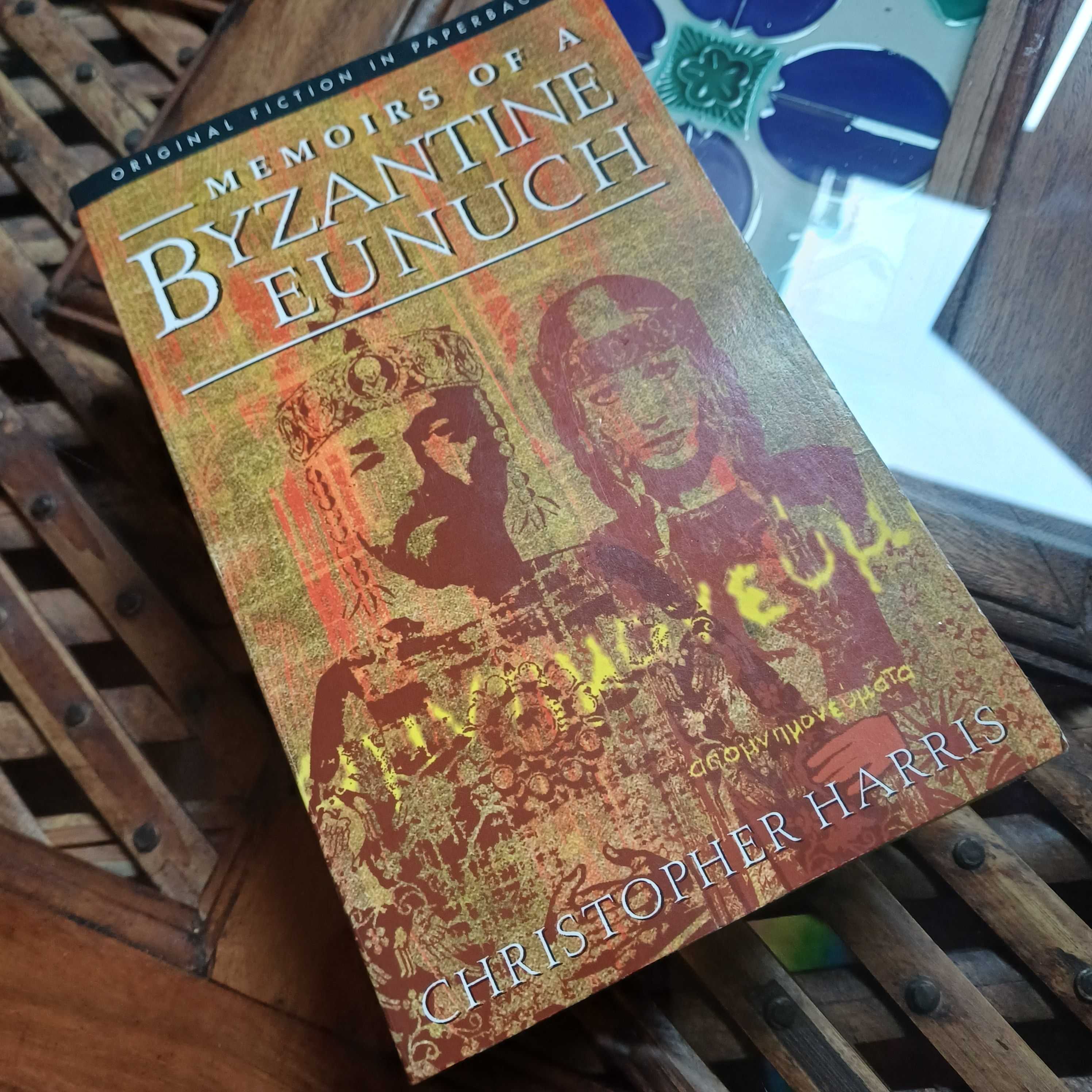
The story opens with Zeno, our narrator, as an old man looking back on his time as young boy in a remote town of the Byzantine empire. An intact young boy.
Although, before the story really starts, we get a glimpse into the position that a eunuch held in that time:
“If you still had your balls,” the charioteer muttered, “I’d cut them off.”
How often have I heard that said! Whole men think it witty and original.
Page 11
Eunuchs were generally looked down upon during the whole of antiquity. The vast majority had no say in what was done to them, many like Zeno were castrated as children (see page 26).
Young Zeno is taken by his captors to Constantinople where his master marries the owner of a tavern:
I had to lie with my head between her breasts, keeping her warm and comforting her. Even a eunuch can please a woman. We He can do with his hand what he cannot do with his member.
Page 33
Basically, Zeno is used as a human hotwater bottle by his mistress.
From there, Zeno is bought by a naive scholar called Constantine, keen on researching barbarian pagan languages with a view to converting them to Christianity. However, his friend (and funder, Photius) responded upon seeing young Zeno:
“That eunuch. You know I can’t bear them. Nasty, hybrid, androgynous creatures, neither one thing nor the other. They violate logical categories, and break the laws of generation. A eunuch is an affront to nature, and it’s Creator”
Page 41
Photius does eventually become Zeno’s friend.
During this time Ignatius, patriarch of Constantinople was a eunuch. He was the brother of the emperor, who had him castrated at the age of fourteen to render him ineligible for the throne. Many civil servants of the time were also eunuchs. And they were all hated and distrusted by aristocrats. Although, we can’t really know what ordinary people would have thought as they didn’t write much on the subject! The likelihood is that eunuchs were widely reviled.
Eunuchs from the antique world or Greece and Rome were often castrated through discreet surgury without damaging too much of the surrounding tissue (that’s when they were involuntarily castrated, self-made eunuchs such as the devotees of Cybile we think removed the whole shebang). I guess that made survival rates better. I have seen Roman castration tools though, or what are described as castration tools – to my ignorant eyes they looked designed to cause maximum pain and humiliation … whilst probably guaranteeing the death of the victim.
Other cultures perform castration differently:
“He is not one of those clean-cut eunuchs the Saracens favour”
Page 65
I guess that the Saracens, like the Chinese, remove the whole kit and caboodle!
As I gazed at her, I realised that I too was not a statue. I had feelings. I noticed a strange stirring in my in innards, an errant beat of the heart, a prickling of my skin, even a twitching of my little member.
Page 118
This is true. Even without hormones, a eunuch may still be stimulated. What is different is the urge to seek out that excitement. Eunuchs are not necessarily asexual, but when not on replacement testosterone, our libido and sexuality is dialled down low – but we remain gay or straight or whatever we were before our testicles were removed.
There’s a rather sad passage in Zeno’s voice:
Some ancient philosophers have defined life in a way that excludes eunuchs. According to them, a living creature must be able, in addition to moving, eating, breathing, and so on, to be able to make more of it’s own kind. Something like me, that moves and speaks, but cannot reproduce itself, must be a sort of animated statue.
Page 208
All his life, after the violation that robbed him of his manhood, he was less-than everybody else. He knew that he was damaged goods – but he pushes against the boundaries and prejudices that his society imposed on euncuhs in a believable way – he had to manage the various forces that pushed him around. What Harris does really well was to make me care about Zeno and what happens to him. He created a character that is a strong contrast to the other eunuchs of his day.
Harris gets what I know to be true about eunuchs made before puberty right. Post puberty eunuchs, like myself, are different and generally look like men.
I know much less about the medieval Byzantine empire – my period is ancient Rome and Greece, and my curiosity has led me to late antiquity and western European medievalism – but I am happy with Harris’ treatment of the age.
At the back of the book are snippets from reviews on newspapers and magazines. I don’t know why some of them were put in because they read as a little ambivalent!
However, I loved this book and am glad to add it to my collection.

Leave a Reply