
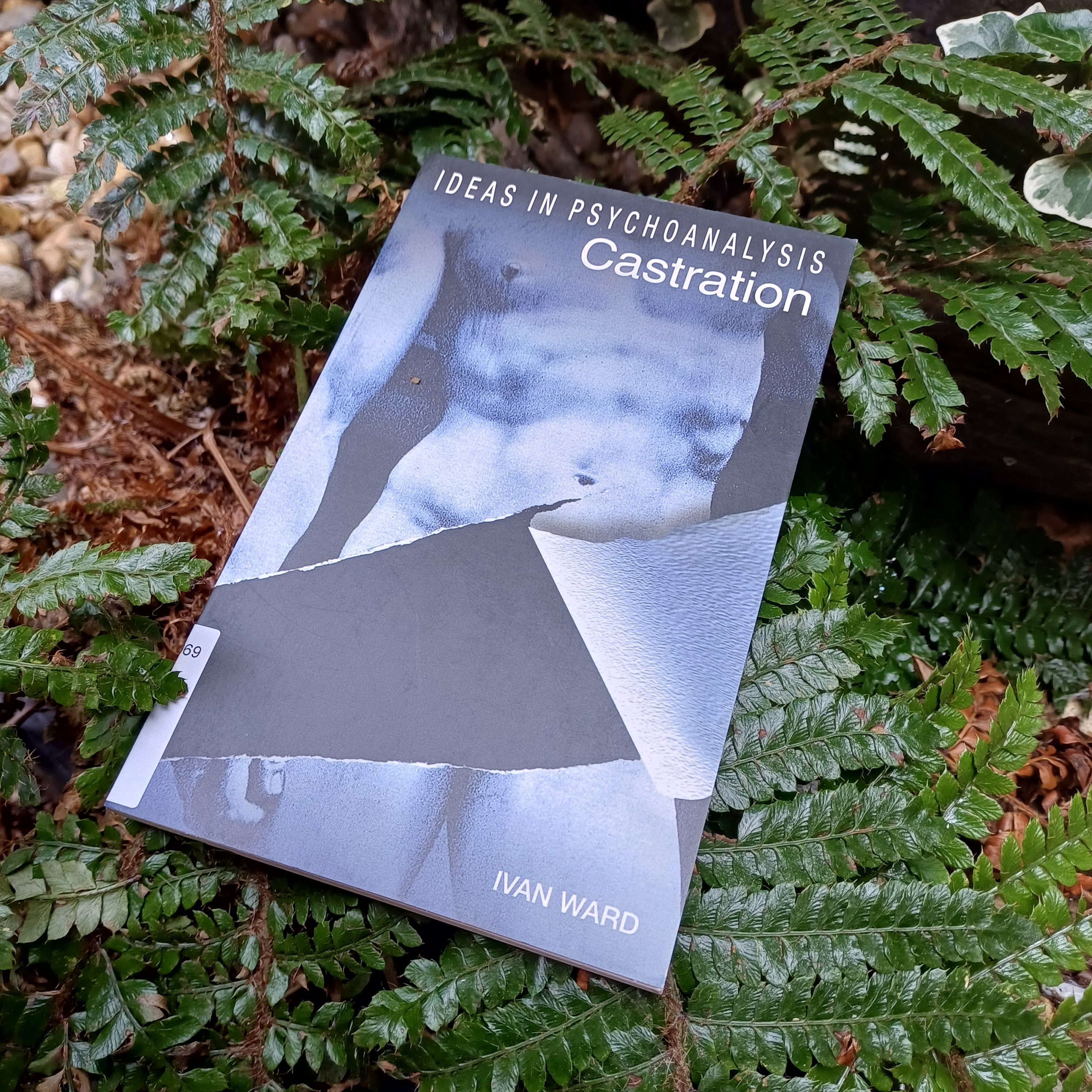
The first sentence immediately got my back up: “The castration complex is a constellation of childhood beliefs that pertain to the drawing of a fixed sexual identity.” Mid-way through the paragraph a footnote indicated a reference. To Freud. Not to research or anything remotely scientific with theories, tests, controls, and the like.
It’s worth mentioning here that Freud’s concept of “castration anxiety” referred primarily to the loss of the penis, rather than the removal of the testicles.
Then I was struck with the “Emotions range from the initial refusal to believe such a preposterous idea, through outraged defiance, to acute anxiety and eventual capitulation.” Basically, the author is saying ” if you disagree with me, you’re wrong and you will come round eventually”.
The premise is that children are so traumatised by the fear of castration (boys and girls, who supposedly think that they were castrated) that they forget all about it. And it’s only during psychoanalysis that the fear is rediscovered.
Then follows some dubious analogy with astrophysics where the author says that just like a black hole can be detected by it’s affect on surrounding objects in space, so can the castration complex be detected by it’s affect on behaviour. Big difference: the existence of a black hole is calculated based on sound mathematics and demonstrable scientific principles. The castration complex is at best a theory that can be made to fit facts – but it is not the only available interpretation.
Examples are given in the book of a fear of castration in children, but these strike me as isolated examples and insufficient to prove anything. And completely lacking is any idea that a control sample is required.
As I read on, I’m rather struck by the author’s (and by extension, Freud’s) castration fixation. I’m not reading anything that gives me any insight into myself, or others like me. Unconnected examples are related back to castration and I am not able to follow the leaps.
Ward states “The seductive mother on the other hand, at one time a source of temptation and sensual pleasure, becomes the most feared creature – a woman – ‘physically strange and repulsive, genitally mutilated, controlling and demanding ‘” (page 25). I can’t imagine what world he was living if it he got a good look at his mother’s genitals! And as for “repulsive” I don’t know how that fits into a world where most people are straight. And does this same assertion by Ward also apply to women? He’s just coming across as a misogynist.
Ward repeatedly swings from very specific examples (in which he may or may not be right about castration anxiety) to wild generalisations – which, from somebody who isn’t a psychoanalyst, appears to be a constant pattern of the discipline.
Then he moves into castration in films. Except he doesn’t. He gives descriptions of plots that have zero to do with castration and finally announces that castration was what the whole thing was about. Sorry, but I really have no idea what hallucinogens he was taking to come to those conclusions.
On page 63, Ward goes into a lot of detail about Damien Hirst trying to build us up to some understanding that Hirst has castration anxiety. Finally, Ward accuses Hirst of not being able to engage with the sea shell as a symbol of the female vagina. Tosh. Ward has assumed that the language of symbols is universal. It isn’t. Sometimes a sea shell is just a sea shell.
I really do not know what Ward is on about when he says that Aphrodite rules castration cults like Anchises and Adonis. Anchises was the father of Aeneas, the legendary forefather of Rome. And Adonis was just a dishy mortal. I believe that neither mention their genitals.
The book finally ends with a list of assertions: “the castration complex is…”
Ward didn’t take me on his journey. He was unable to convince me of anything, nor enlighten me about anything within myself.
Perhaps that is to do with my immediate feelings upon reading the book’s opening. Maybe it’s just a shit book.
Ultimately, Ward conducted no research himself. He stitched a load of random stories and drew threads between them, that to me highlight a determination to support a half baked theory.
Nor, as far as I can tell, did he talk to any eunuchs to find out how actual people who have experienced castration understand their own motivations and feelings. That seems like a rather significant omission in a book so fixated on castration.
Conclusion: not a useful book!

Leave a Reply