
I think that almost all of the sci-fi books that I have ever read were written by men. Asimov, Frank Herbert, Arthur C Clarke, Bradbury, to name the most memorable to me. Of course, there is The Hunger Games by Suzanne Collins is a sci-fi written by a woman that I have read!
Apart from Collins, there were no others to my knowledge until I read The Left Hand of Darkness by Ursula K Le Guin.
For me, sci-fi and fantasy are about creating worlds where thought experiments can be conducted: what might happen when society is organised in this way or that way. All of my favourite sci-fi and fantasy authors do that very well, constructing entire universes where today’s rules don’t always apply – or even worlds where today’s rules do apply and you can see them for what they are! ie stupid!
Until I read Le Guin, most of the worlds focussed on socio-political experiments. Le Guin introduced me to a new idea of sociological experimentation by creating a society where people are effectively gender-neutral except during periods of fertility.
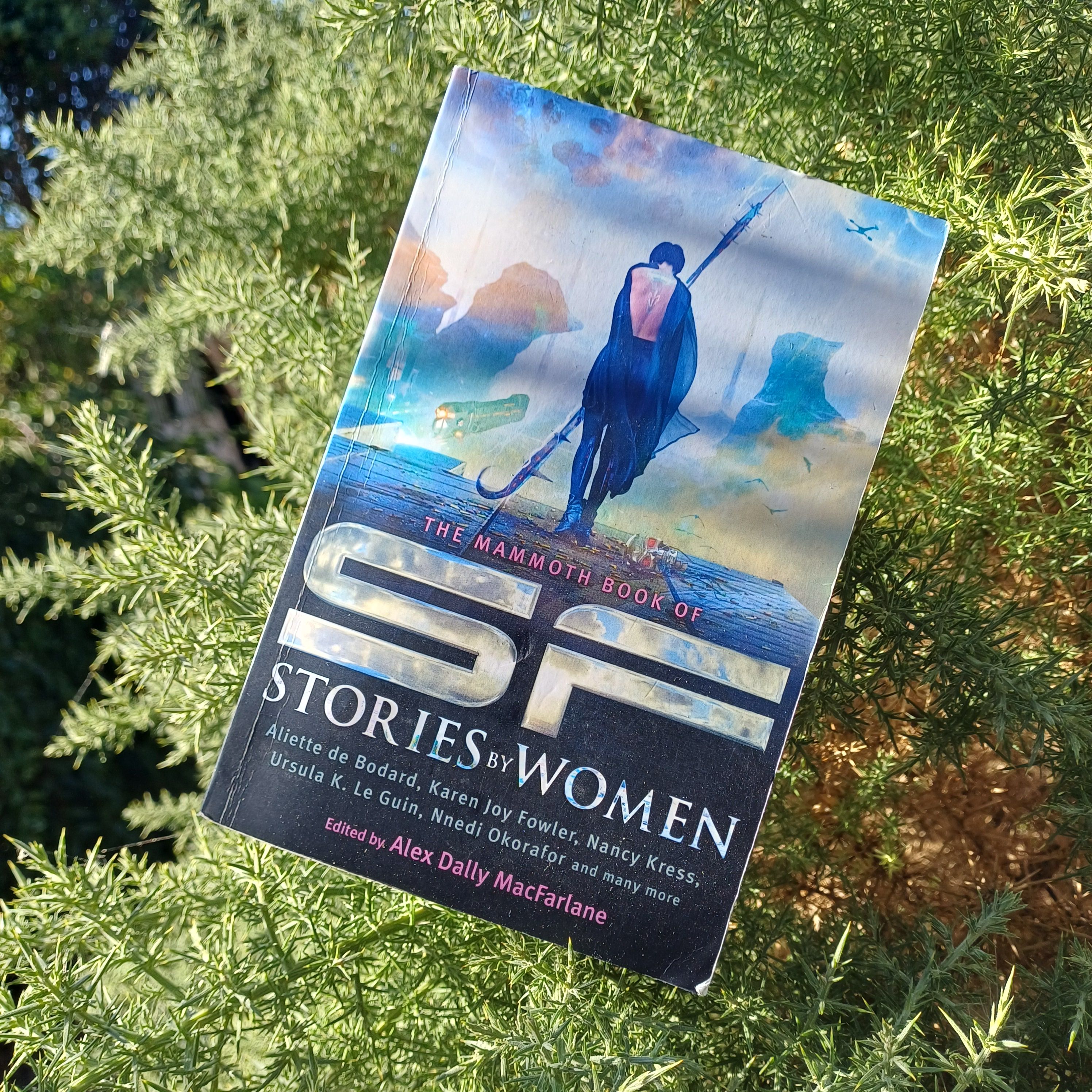
I wanted to read more female authors to see whether Le Guin was unique, which is where The Mammoth Book of SF Stories by Women comes in.
The stories were as mixed a bag as anything you’d find in the more regular male dominated novels and anthologies. Strange worlds and strange societies. Some were quite dull to my mind. Gender was explored by creating female protagonists in place of the males that often proliferate – representation is important: sometimes the novelty wasn’t the world-building at all, but simply seeing women occupy roles that male protagonists usually fill. There were a couple of lesbian relationships.
A couple really spiked my interest.
The first was The Queen of Erewhon by Lucy Sussex, who explored lesbian love and the rules of relationships. This was my first encounter of a strong female-led narrative in the book.
Astrophilia by Carrie Vaughn explored polyamory and lesbian love . I have never read a sci-fi novel that suggested that women and men could both enjoy a polyamorous relationship (something quite different from the male-centred harems that occasionally crop up in fiction). This story pulled me through as I wondered how the unique relationship configurations defined by the customs in the story would play out.
The Science of Herself, by Karen Joy Fowler, is a short biography of Mary Anning – the woman who really started fossil hunting and really put Lyme Regis on the map. It was enjoyable because I already knew a little about Mary Anning.
A couple of stories explored the experience of racism, both the earthly kind of colour-based prejudiceand interstellar prejudice. Interesting just for offering a femal view in a traditionally male-dominated genre.
Ursula K LeGuin’s story Mountain Ways also explored complex gender and sexualities in a polyamorous marriage. I am growing more interested in Le Guin and will find more of her stories to read.
If this selection of sci-fi stories is anything to go by, then women cal also write stories that are boring – or interesting and exciting – as well.
If this anthology taught me anything, it’s that women don’t write a different kind of science fiction so much as they often choose different questions to ask. Instead of asking how empires rise and fall, or how technology reshapes civilisation, many of these stories were asking what happens when we rethink gender, sexuality, relationships, prejudice, or identity. Those turned out to be thought experiments I found every bit as fascinating.

Leave a Reply