
History is full of men with swords. Kings. Conquerors. Founders of nations.
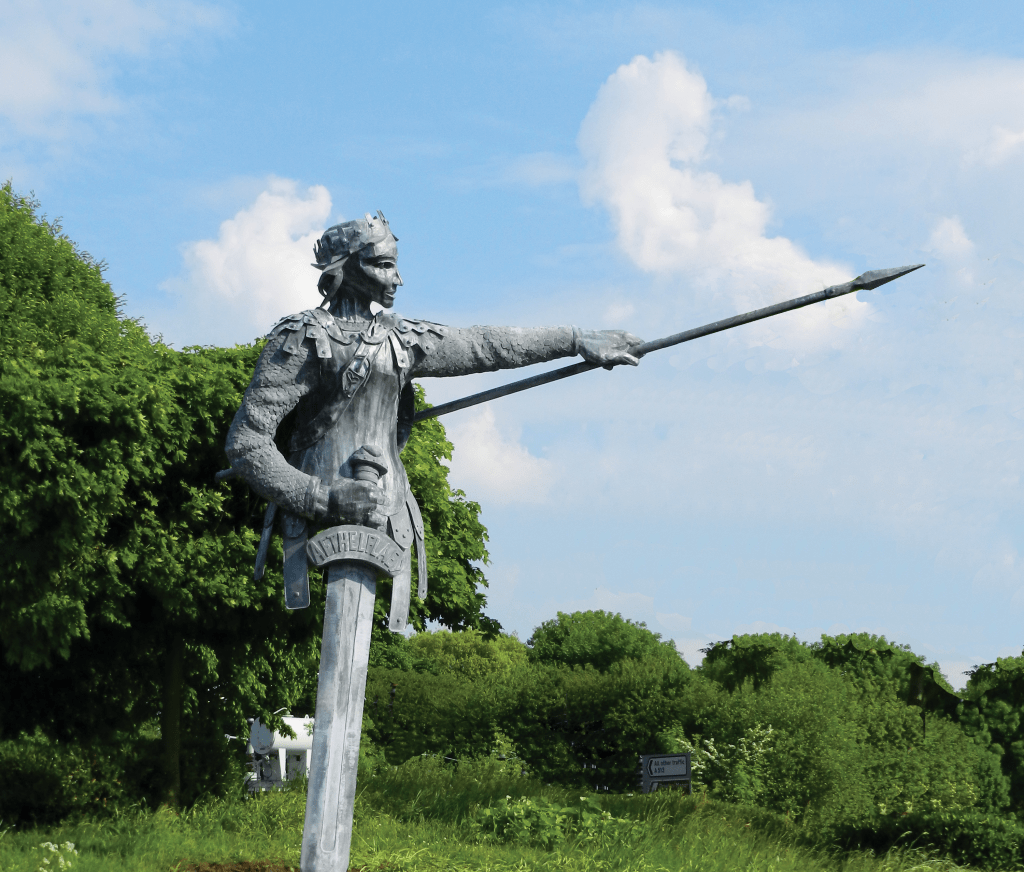
But every now and then you stumble across a figure who makes you wonder why we don’t talk about them more. One of those people is Æthelflæd, the Lady of the Mercians: she might just be one of the most important people in the creation of England.
Most people have heard of Alfred the Great, according to 1066 And All That was an “incendiary king” famous for the burning of cakes – although he is key to our history as the king who fought back against the Viking invasions and began the long process of reclaiming England from Danish rule. But far fewer people know about his eldest child, Æthelflæd, who quietly carried that project forward after his death.
She didn’t just inherit a kingdom – she inherited a war.
Growing up in a Viking world
Æthelflæd was born around the year 870, right in the middle of the Viking invasions of Britain. At the time, much of England had already fallen to Danish armies – with Battle of Edington in 878 marking the moment when Alfred finally began to push them back.
So her childhood wasn’t the peaceful upbringing we often imagine for royal daughters: she grew up watching a kingdom fight for survival.
And like many royal daughters of the period, she was married for politics. Around 885 she married Æthelred, Lord of the Mercians, the ruler of the neighbouring kingdom of Mercia – a marriage designed to cement an alliance between Mercia and Wessex.
At first glance, that sounds like the end of the story. Princess gets married. Job done. Happy ending and all that crap.
History and Æthelflæd had other ideas.
From noblewoman to ruler
While her husband ruled Mercia, Æthelflæd was already deeply involved in governing the kingdom – witnessing charters, supporting churches, and helping organise the defence of Mercian towns.
Then things changed around the early 900s, Æthelred’s health began to fail. And instead of quietly fading into the background, Æthelflæd effectively stepped into his role. By the time he died in 911, the transition was almost complete.
The Mercians accepted her as their ruler – not as queen (the title had fallen out of use – that’s another story), but as “Lady of the Mercians”.
In practice, though? She ruled like a king.
The war against the Vikings
Æthelflæd didn’t just sit in a hall issuing decrees – she was busy leading campaigns.
Working alongside her brother Edward the Elder, king of Wessex, she led the campaign that gradually pushed the Vikings out of central England.
One of her key strategies was building and repairing fortified towns – the Anglo-Saxon burhs. These were defensive strongholds that protected trade routes and allowed armies to move quickly across the landscape.
It was practical, strategic warfare – and it worked.
By 917 she had captured Derby, one of the Viking strongholds in the Danelaw, and by 918 Leicester surrendered to her without a fight.
She wasn’t a symbolic leader wearing all her regal finery at Tilbury Dock while the battle raged elsewhere. She was in the thick of things and actively shaping the political map of England.
A curious personal choice
One intriguing detail about Æthelflæd’s life is that she seems to have chosen not to have more children after the birth of her daughter Ælfwynn.
Some historians believe she deliberately remained celibate – possibly to avoid producing a male heir who might threaten the political balance between Mercia and Wessex.
If that interpretation is right, it shows something striking about her priorities in that she was thinking not just about family but about the stability of kingdoms.
The ruler history forgot
Æthelflæd died in 918 at Tamworth (we don’t know of what – probably something mundane like illness – she was only 48), the traditional Mercian capital.
For a brief moment her daughter succeeded her. But the experiment didn’t last long because her brother Edward quickly took control of Mercia, folding it more tightly into the emerging English kingdom.
And slowly, over the centuries, Æthelflæd slipped into the background of history. Not because she failed, but because the story of England came to centre kings – a successful female rule ran contrary to the whole patriarchal regime.
Why she matters
If you step back and look at the bigger picture, Æthelflæd’s career is extraordinary.
She governed a kingdom, she commanded armies, she built fortified towns, and she helped defeat the Viking presence in central England.
And she did it all in a world where women were almost never recognised as rulers – almost certainly she couldn’t have ruled the neighbouring kingdom of Wessex because that, like so many nations of that time, actively barred female rulers.
Her inconvenient existence as a competent and successful female rule was suppressed to protect the delicate egos of the men of the age.
Without her, the creation of a unified England might have taken a very different path.
Yet she’s still oddly obscure – a historical figure who should probably stand alongside the great rulers of early medieval Britain.
Or, to put it bluntly: England remembers Alfred.
But it should remember his daughter too.
 Eunuchorn
Leave a comment