
If my early childhood was dominated by Star Wars, my teenage years were dominated by Star Trek – specifically The Next Generation – I loved the space opera and the adventure, and the effects were ground-breaking – and I loved the moral insights it delivered.
For me the point of science fiction and fantasy isn’t just about flashy pyrotechnics and prosthetics, but the social experiment of removing humans from the constraints of the modern world. What possible sense is there in human racism when there are different species? Or sexism or homophobia in a universe with no gender or multiple genders? Or ableism in a universe where mental and physical constraints can be compensated for?
Picard was a man with wisdom, intelligence, and strength, yet nourishing – the father of his ship. He showed what masculinity could be.
Picard’s Words of Wisdom
The series’ writers gave Picard, played by Patrick Stewart, so many of the best lines – capitalising on his commanding Shakespearean delivery to add gravitas.
It is possible to commit no mistakes and still lose. That is not a weakness; that is life.
🖖 Jean-Luc Picard in Star Trek: The Next Generation
What a life lesson that is! You can make no errors and yet still not succeed. Failure isn’t always a failing in me (or you).
Seize the time… live now! Make now always the most precious time. Now will never come again.
🖖 Jean-Luc Picard in Star Trek: The Next Generation
A much briefer summary of my favourite Marcus Aurelius quote (“think of your many years of procrastination…”)
With the first link, the chain is forged. The first speech censured, the first thought forbidden, the first freedom denied – chains us all irrevocably.
🖖 Jean-Luc Picard in Star Trek: The Next Generation
Another version of “no man is an island”. This quote is a powerful statement in defence of the freedom of speech. These days it sits a little less comfortably with me because this same logic can be used to justify permitting hate-speech.
Someone once told me that time is a companion that goes with us on the journey. It reminds us to cherish each moment, because it will never come again.
🖖 Jean-Luc Picard in Star Trek: The Next Generation
When he first joined the show, the other cast members thought he was so stuffy – he liked to warm up and took everything so seriously. He didn’t expect the show to last – or to keep his job if it did. The cast jokingly called him “Sir Patrick” even before he was knighted.
They cracked him and the cast had a great time – and Sir Patrick learned to unwind.
Sterling’s Wit and Wiles
Straight after The Next Generation aired its final season, Patrick was in a gay film playing the camp, wise, funny, and heart-warming character Sterling. This was possibly the first gay film that I saw at the cinema – and to see a well-known straight actor playing a gay role blew my mind. Being gay in Hollywood was still thought of as career ending. This was also the height of the AIDS crisis – which was the film’s underlying theme.
Can I do this, or will I look like some sort of gay superhero?
🏳️🌈 Sterling in Jeffrey
Says Sterling as he ties a pink sweater (probably cashmere!) around his neck and knots the sleeves. At the time he and his partner, Darius, are supporting the Pink Panthers, a gay equivalent of the Black Panthers to help prevent gay-bashing. Literally his role is superhero.
I was watching these two guys on Nightline on Gay Pride Day, and one of them said “Hi. I’m Bob Wheeler, I’m an attorney. And this is my lover, and he’s a surgeon. And we would like to show America that all gays are not limp-wristed, screaming queens. There are gay truck drivers and gay cops and gay lumberjacks,” and I just thought, “Ooh! Get her!”
🏳️🌈 Sterling in Jeffrey
One might suggest that Bob Wheeler’s put down of “limp-wristed, screaming queens” is a form of internalised homophobia – a fear of appearing gay and hating the stereotypes around homosexuality.
Sterling puts Bob down with humour at the same time affirms his Pride in himself and the whole queer community.
She writes picture books about gracious living. Martha says that nothing else matters if you can do a nice dried floral arrangement. I worship her.
🏳️🌈 Sterling in Jeffrey, in response to “Who’s Martha Stewart?”
By now, you’d get the idea that Sterling was a vacuous air-head with the emotional depth of a puddle. The trap is set!
Leave this house.
🏳️🌈 Sterling in Jeffrey; answering “And, um, who’s Ann Miller?”
Haven’t I said this very same kind of thing to people who don’t know Star Wars? More usually when they profess their love of Trek or Star Wars I’ll say “and that is why we are friends”. Same silly, playful thing really.
You know, Darius once said you were the saddest person he knew. Because he was sick. He had a fatal disease. And he was a million times happier than you.
🏳️🌈 Sterling in Jeffrey
And there we have it: Sterling says something profound.
This role mattered to me in my early coming out years and in the time of terror of the AIDS crisis because of the gravitas that he carried forward from Star Trek.
He showed being gay as fun – and safe.
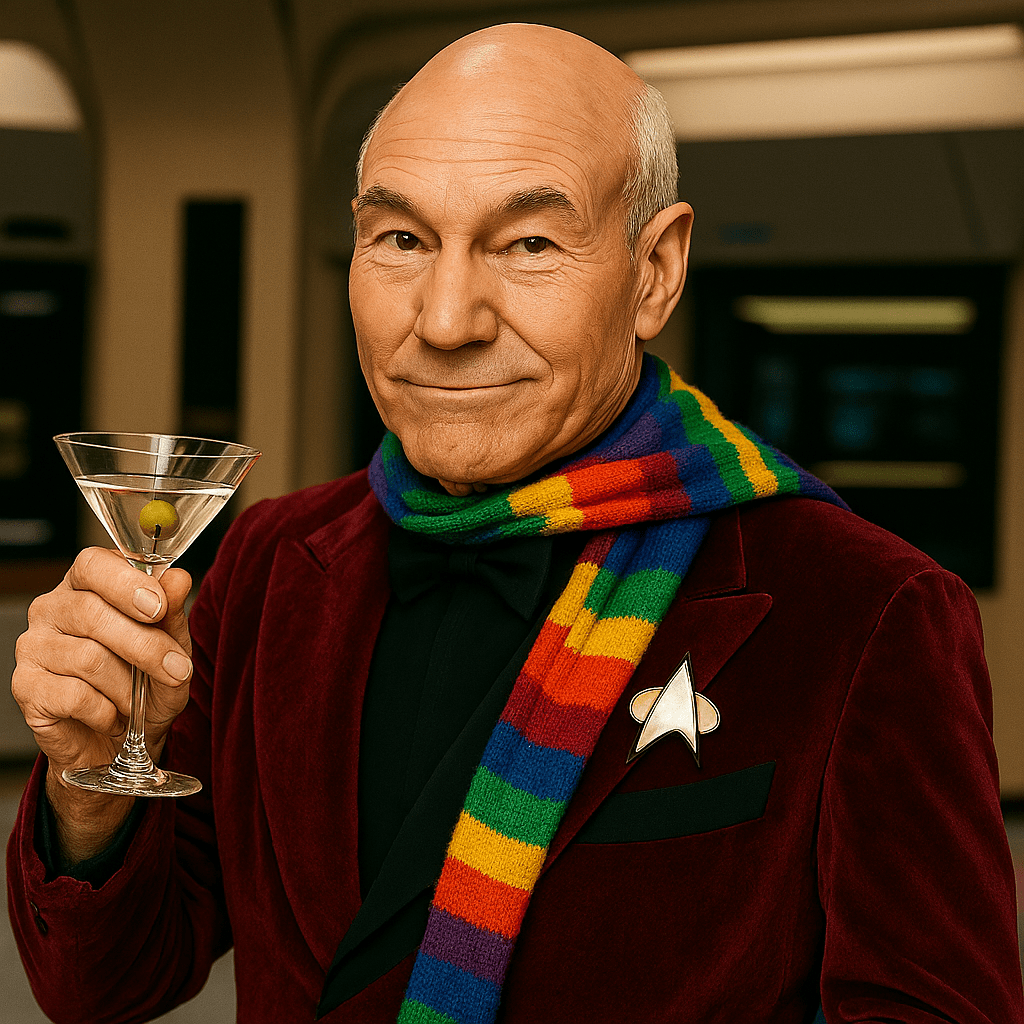
Picard and Sterling – two sides of the same coin
Both Picard and Sterling are emotionally intelligent men, Picard being stoic, cerebral, and duty-bound, whereas Sterling is flamboyant, self-aware, and sensuous. But both men contain their emotions – they do not deny them.
Patrick Stewart’s acting philosophy (and personal one) is about truth through restraint, not repression. That’s what makes both of these characters humane.
Courage in Context
Star Trek: The Next Generation ended in 1994.
Patrick Stewart accepted Sterling in Jeffrey in 1995.
1995 was still the height of AIDS stigma; straight actors feared gay roles. Many gay actors still couldn’t come out.
Accepting an openly gay role at that time was quietly radical; Patrick was able to use his Hollywood profile to do something that other actors could not have done. Possibly his Britishness also gave him some freedom of choice – it gently othered him in the American eyes and made the character’s eccentricity acceptable. An American actor might still not have felt able to take the role.
He chose not to play the part as caricature or parody; he gave Sterling grace, intelligence, and moral depth.
That’s allyship at its best: not posturing, but showing up with empathy and craft.
Patrick’s Personal Philosophy
Patrick is known for his principled stand on a number of issues:
- Activism against domestic violence (for Refuge)
- Friendship with Sir Ian McKellen and public defence of LGBTQ+ rights
- Reflections on vulnerability – “acting is about revealing, not pretending”
These reflect a masculinity built on ethics, intellect, and empathy, not dominance.
In both Picard and Sterling, he embodies leadership through love – different costumes, same core.
In Jeffrey, Stewart shows us what happens when the captain of the Enterprise trades his uniform for chiffon and irony. The same moral clarity remains, just now lit with laughter. He reminds us that courage can sound like command – or sparkle like wit – but it’s always the same heart underneath.
 Eunuchorn
Leave a comment