
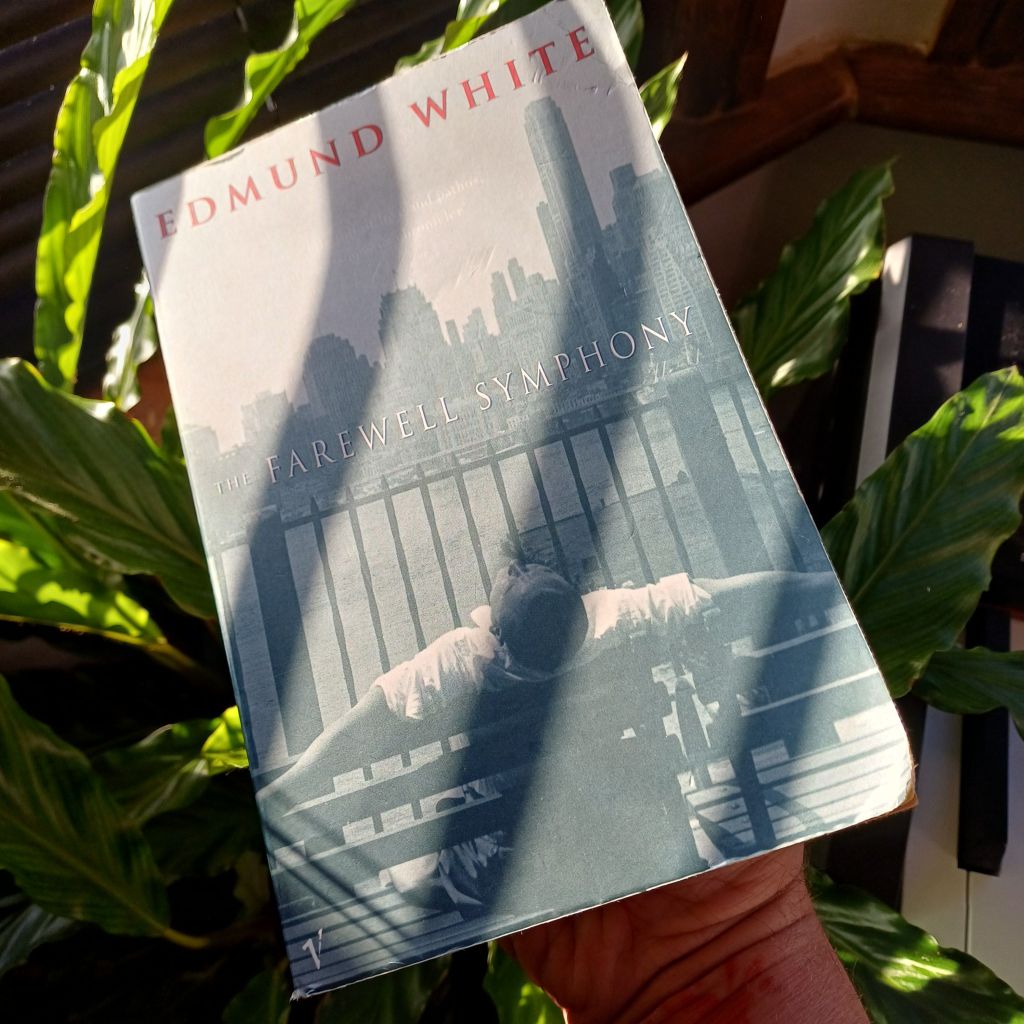
At first, I wasn’t certain that this was the sequel that I thought it was. I double checked Google to which confirmed that it was. Then the first person style began to now strongly resemble the style of the earlier books and confirmed that the protagonist was still the “boy” of the first two books.
By page 20 we learn that the “boy” is now a white-haired and flabby older person who is HIV+.
It may seem strange to that a three-day riot could affect something so subjective as love, but of course what the Stonewell uprising changed was not love so much as self-esteem, on which mutual love depends
Page 34 – the text in the book reads “Stonewell” rather than “Stonewall”
Ru Paul is famous for saying “if you can’t live yourself, how the hell you gonna love somebody else?”, which boils down to much the same thing. I don’t think it’s that one cannot love another if one doesn’t have some love for oneself, but I don’t think that it can be a healthy love.
I think what my husband and I have developed is love, but it’s tainted by co-dependency. Our love had a strong unhealthy element to it.
The story moves through Paris to Rome, where “boy” seems as little happier and is accepting and enjoying his sexuality, as he navigates the strange ways of Italians as understood by Americans.
I enjoy the descriptions of Italy, and the occasional dips into Italian – a beautifully musical language that I love to twist my lips around.
One chapter describes a couple who visited “boy” and go with him to Capri. The way the relationship is described I wasn’t completely certain whether this was a straight or a gay couple. When the two of them seduce “boy” (if seduce is a word to be used of someone so compliant), I understood them that this was a gay couple who enjoyed having sex with a third occasionally. “Boy” hopes that he finds somebody to live him as he sees those two love each other.
It’s interesting to note that “boy” had worked, while in New York, to beef up. Yet in Rome, he was “double bodied” meaning strong like a farm labourer – and therefore unattractive to Italians. I found myself wondering to what extent sexuality was a social construct? Are the “types” we are attracted to at least in part dictated or influenced by cultural norms?
I feel that my preference for hairy, beefy guys is intrinsic to who I am and my ideal of masculinity… if I had been adopted and brought up in a different society, would I be attracted to that society’s idea of masculinity?
While in Italy, he writes a screenplay for an actor that he has as crush on. The film contrasts Italian with American attitudes to women – neither particularly favourably. The play is rejected by all the producers he sent it to, with one being angry that it suggested that Italian men are disrespectful to women and they love women. Therein lies the problem: that those responsible for funding the production of films (and to a lesser extent books) sometimes have a vested interest in making sure that certain perspectives are not made visible.
At the start of chapter 4, “boy” quotes a book review he’s reading at the time of his partner’s death” greatest banality: we want to share our grief with the dead”.
That was my experience with my mum – I wanted her to know that I missed her, that I was heartbroken – that I miss her, that I am heartbroken.
It was unexpected because nobody had ever said that was how grief felt. I understand that grief is different for each of us, yet I suspect that this is a universal (or largely universal) truth: the person we most want to know how we feel is the one whom we have lost.
Why is that? It’s it because we want to punish them for causing us pain? Not in my mum’s instance, but I could imagine that for others. For me it would just be because it’s another way to say “I love you” because the pain of loss is linked to the love that we had.
The use of language in the book is much more refined than in the previous two, as though to reflect the life experience of the writer distancing himself from his more naive youth, as though the first two novels were published immediately by their narrator – however the story itself makes clear that nothing was published until late in the “boys” life.
Useful hint: make sure you have your phone handy, there are lots of rare English words and plenty of foreign phrases that you might find useful to translate.
…you can’t imagine how a woman feels when she loses a breast, it’s as though she’s been castrated, for you, it would be the equivalent of castration, so I was feeling very vulnerable…
Page 323
This extract from something that “boys” mother says about her mastectomy is something that I have thought about bodily loss, gender, and identity. Women go through a menopause sometime in the middle of their life. It just happens and could be regarded as part of what it is to be a woman. The loss of a breast though? That’s not part of a woman’s natural cycle. Is that a reasonable equivalent to castration? It’s a shame there is no modern Tiresias to tell the tale.
Family life binds strangers together.
Page 487
Oh this is so true! I have nothing on common with either my dad or my brother – much less with my dad.
I speak to him once a week from a sense of duty; I have grown affectionate towards him, but he is a stranger and almost as unlike me as one can get, except possibly in our neuro-divergence. He rarely talks of my mum – his wife – and when he does, the person he creates isn’t the person I remember.
With my brother, there is perhaps more than affection, but even with him what we have in common is still limited to the relationship with our mother and father: we experienced both of them in similar ways. We have nothing else in common.
Neither my father nor my brother would be in my family of choice.
I wonder how many others feel somewhat similar towards their birth family – that they are strangers with a shared genetic heritage, but that’s where the connection ends?
…since the gradual collapse of the Evil Empire of Communism left nothing to unite the rich few and numerous poor on the right into the semblance of unity except a factious agitation over “family values”.
Page 495
So wrote Edmund White in 1997, while the AIDS epidemic had moved to being endemic, foreshadowing the rise of the TERFs and GERMs in the 2020s. The political extremes always need a bogeyman to frighten people into following the demagogue’s pipe towards persecution and destruction.
White skilfully creates (recreates?) fascinating, colourful, vibrant, eccentric, wonderful humans – you can’t help thinking that there’s far too many of them for one person to have encountered in their life – then think that White got the ideas somewhere – these are probably sketches and amalgams of people that he knew.
He knew.
White’s telling of the AIDS cataclysm that destroyed an entire generation of gay men and left deep scars on any who survived it is a deeply moving account that finishes the arc of child terrified of of his sexuality, to adolescent ashamed, through the start of sexual liberation and the explosion of sexual expression in the gay community, to the apocalypse that transformed that liberation.
A must read

 Eunuchorn
Leave a comment