
Meltdowns
Today at counselling I wanted to talk about my meltdowns. Sometimes I get angry – I suppose that I should say that I never thought I did anger, but I’m aware that I can feel anything from irritation to rage and not have the foggiest that’s how I am feeling – at least now I’ve got some awareness.
My anger: I say things that are hurtful towards my husband, and he has carried them and not been able to get me to take responsibility for them until recently.
Cruel words
One such example comes from our early relationship. I didn’t have much interest in topping, he didn’t like the idea of bottoming. His sex drive was higher than mine, and at one time he said that if he couldn’t get his needs met with me, he might have to look elsewhere.
I struck back. Rather than saying that sometimes I got very sore, I told him that he “want on too long”. Rather than saying when it’s not clean, then I feel shame and embarrassment, I told him that he only felt that he could express love through sex because of his history. When he tried to initiate sex, I told him to “stop pawing at me”. I told him that his sex drive was abnormal.
In that way I undermined his sexual confidence.
These things come up a lot at the moment, probably a quarter of a century after they were said, because it turns out that I’m the one with the kinks and gender divergence.
Stuck in the past?
My counsellor asked what he got by continually bringing up that past. I do not know.
Richard (that’s my counsellor) observed that my husband seemed stuck in the past and trying to keep a hold of the bad image of me that he holds from that time.
I said that my husband and I have mental models of each other. I’ve realised that mine is faulty, and as a result it makes inaccurate or invalid predictions of how my husband will react or feel about a subject. He holds an out of date model of me; Richard observed that people change – they must change – and asked why he is holding onto that old mental model.
I guess there’s some reassurance in it for him.
Richard thought that it might have been a bit of attempt to address a power imbalance.
Logical
Sometimes when my husband and I talk, I’m very rational – especially when I am focussed on solving a problem.
My husband complains that I’m cold and unfeeling.
Richard said that taking the time to talk and analyse things is caring.
I said that I should say to my husband that was my reaction.
Historical perspectives
My husband’s memory of things tend to be much better than mine. If he says I said something, I tend not to doubt him. I know that I tend to discount minor differences in memory, when I’m certain of one thing and he’s certain of another, when it doesn’t feel like it matters.
Richard wondered whether I accepted my husband’s recollection without questioning it enough when mine is fundamentally different. This is possible – I lack the confidence to assert my memory a lot of the time, although now I think of it, I realise that sometimes I just dig my heels in and refuse to budge on a memory or point!
Being stubborn is not a virtue!
The nuclear meltdown
Often the conversations with my husband circle back to the big meltdown that I had on his eldest daughter’s front garden. It had terrible ramifications for my husband because, as a result of it, his three daughters ultimately stopped contact with him and he lost his family.
I carry a lot of guilt and shame about my behaviour that day.
Richard said that I had been under unbearable stress with my husband in a psychiatric ward (at that time he was about halfway through a three-and-a-half month stay). He had taken an overdose, and had regularly made further attempts to end his life even in the hospital: they’d had to take his shoelaces, belts, and socks off him because he kept trying to hang or himself.
Richard’s view was that I didn’t need to consider anything other than the pressure and stress too explain my actions.
Self-compassion
If that were somebody else, I could show them compassion for the fear and stress they were living under.
I cannot forgive myself for causing my husband so much pain back then.
I still feel that I need his forgiveness to allow me to let go.
He cannot forgive me.
Not everything is ASD
Some of these meltdown-like episodes I cannot count as ASD meltdowns because they feel like reactions anybody in a similar situation might have.
I need to think about more of these episodes and identity the pattern, which ones are “normal bad behaviour” and which are ASD-style meltdowns.
If I can recognise and understand the patterns, then I can work out strategies to manage them.
Drama triangle
My counsellor thinks that my husband and I are stuck on the drama triangle.
We have to break out of it and move into a winners cycle.
That’s going to require a shift in our perspective from persecutor and victim (we play both roles, I don’t think there’s much rescuing going on).
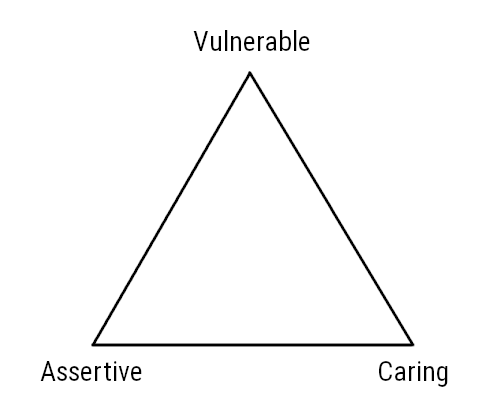
We need to move into an assertive/caring/vulnerable dynamic.
 Eunuchorn
Leave a comment