
When I last saw the mentally health nurse, she talked about “the the brains”: our logical minds, our emotional minds, and our wise minds.
- Logical (or Rational) Brain: This is where we process facts, data, and logical reasoning. It’s all about objective analysis, focusing on the practical side of things without letting emotions interfere.
- Emotional Brain: This part of the brain is all about feelings and reactions. It guides us when we’re driven by emotions—whether that’s joy, anger, fear, or sadness. It helps us connect to our desires, but it can sometimes lead to impulsive choices if we’re not careful.
- Wise Brain (or Wise Mind): The wise brain is a balanced state between the logical and emotional brains. It’s the “middle ground” where we can observe our emotions, consider facts, and make decisions that feel right for both our hearts and minds. It’s about intuition, compassion, and being grounded.
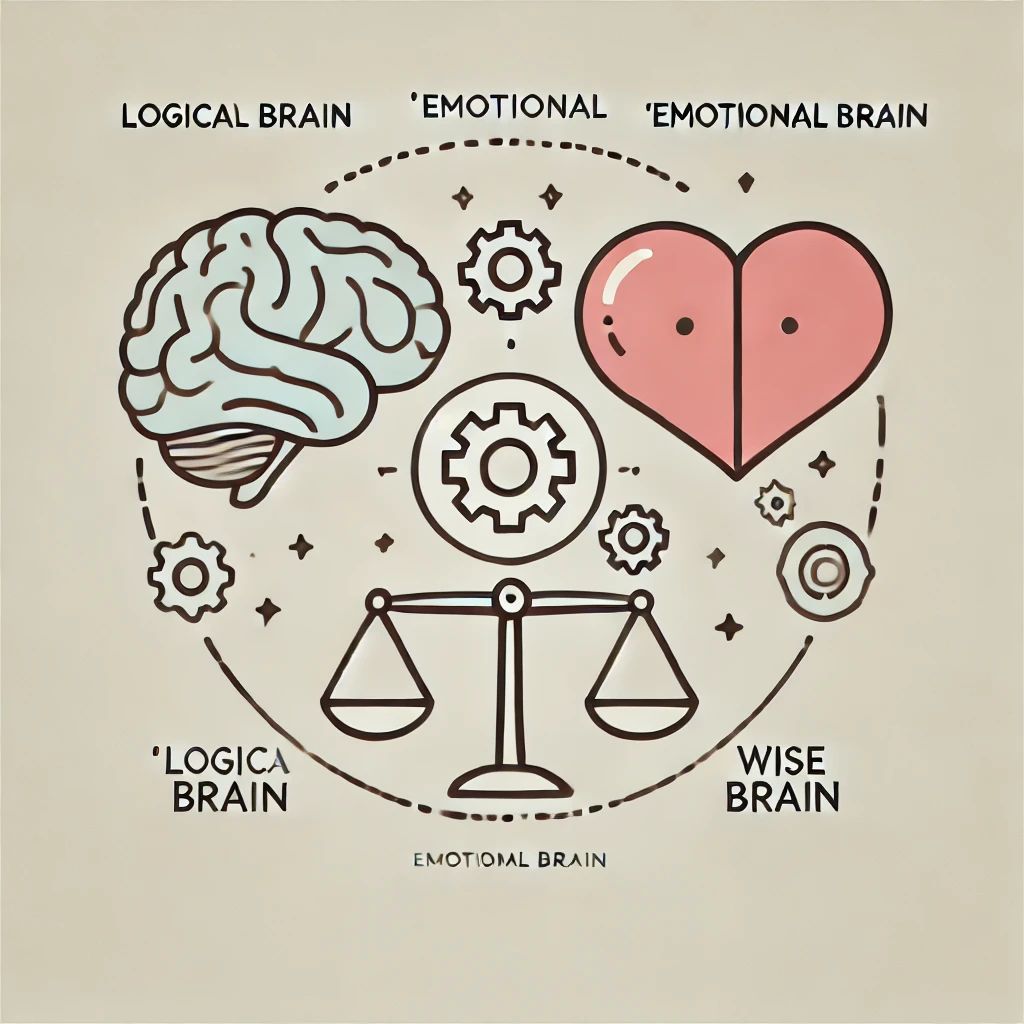
Now I come to reflect on this, I remember that the psychologist spoke to me about the three brains during our sessions. At that time, my self-harming was running amok (as I tried to kill my testicles myself). He said that this was the emotional mind at work. I remember observing that I didn’t seem to be able to shutdown at that time. He said that shutdowns were the response of the logical brain. This is the reverse of what the mental health nurse said.
The mental health nurse said that shutdowns are an emotional response to the flight/fight/freeze crisis. Most people aware aware of the flight or flight response; my brain takes a third route when faced with emotional overwhelm that it perceives as being danger.
I’m confused.
The truth is both of these suggestions could be right:
Emotional Brain as the Source of Shutdowns:
- My shutdowns happen when emotions are too intense or fast-moving, it’s likely my Emotional Brain initiates them as part of the freeze response. The Emotional Brain can feel overstimulated by both self-generated feelings (like those arising in therapy) and by external emotional “input” from others (like a difficult conversation with my husband).
- When the Emotional Brain can’t process or release emotions quickly enough, it may “hit pause,” creating a shutdown to allow the nervous system to regain stability. In effect, the Emotional Brain is saying, “This is too much, too fast – I need to stop.”
2. Logical Brain’s Role in Processing Emotions:
- Although the Emotional Brain initiates the shutdown, the Logical Brain (or Head Brain) plays a part in trying to process the flood of emotions. It might try to make sense of the emotional data quickly but becomes overwhelmed and goes into “circuit-breaker” mode, which contributes to the feeling of being frozen or “glue-brained.”
- When the Logical Brain reaches its limit, it can “hit pause” to prevent further overload. This cognitive slowdown may feel like brain fog, where thoughts become slow or even inaccessible; I describe this as “glue-brain” – the brain simply can’t keep up with processing both emotional and sensory data at once.
3. Wise Brain Integration for Support:
- The Wise Brain can be incredibly useful here as it combines the insights of both the Emotional and Logical Brains. When I feel a shutdown coming on, practicing Wise Brain techniques (like grounding exercises or mindfulness) can help me stay connected with my experience while gently slowing the flood of emotional input. Even with an autistic component, the Wise Brain might serve as a grounding presence, helping me notice early signs of shutdown so I can take pre-emptive steps.
- This can be particularly helpful in situations where I’m talking with the husband or in therapy. I am told that techniques like body scans, deep breathing, or grounding exercises can help engage the Wise Brain before a shutdown occurs. For instance, I try to “check in” with my body during emotionally charged moments, bringing awareness to how I’m feeling and whether a break might help.
Additional Considerations for Autism:
Its noted that autistic individuals often find verbal communication challenging during shutdowns (for example I can become non-verbal, or my vocabulary might be very much diminished), which can make it hard to express a need for a break. It’s been suggested to me that identifying a simple phrase (like a “safe” word!) or even a physical signal (like raising a hand) to indicate a need for space might help in difficult situations.
Practical Strategies for When Shutdowns Approach:
- Recognize Early Signs: When I notice emotions building quickly, try to pause and centre myself. Its been suggested that I try a simple technique, such as taking a deep breath or lightly pressing my feet into the floor can help engage the Wise Brain.
- Express Boundaries if Possible: my husband is slowly beginning to understand how my brain works and to buy-into its foibles and flaws; he is starting to understand that I may be better able to avoid shutdown if I ask for timeout.
- Self-Compassion After Shutdowns: When shutdowns do happen, its been suggested that I need to treat myself with understanding. I am told that the shutdown is a natural protective response, not a failure or weakness, and it can actually show that my Emotional Brain is doing its best to manage complex feelings.
You can read more about this “three brain” model here: Wise Mind | DBT Self Help.
Other “three brain” models
There are other versions of the “three brains” idea; one such idea suggests that we have three centres of intelligence in our body: the head brain, the heart brain, and the gut brain. Each one is thought to process information in unique ways:
- Head Brain: This is our traditional brain, responsible for logical thinking, problem-solving, and planning. It’s where we analyse, reason, and make sense of the world intellectually.
- Heart Brain: Our heart brain is connected to emotions, empathy, and relational intelligence. It’s said to help us navigate relationships and connect deeply with ourselves and others.
- Gut Brain: Often referred to as our “second brain,” the gut is linked to intuition, courage, and a sense of “knowing.” This is where we often feel instinctive reactions or “gut feelings” about people, places, or situations.
Applying this “three-brain” model – Head Brain, Heart Brain, and Gut Brain – to autistic shutdowns and emotional overwhelm can give some unique insights. Here’s how each brain would relate to the challenges I encounter:
1. Head Brain (Logical Thinking and Analysis):
- The Head Brain in this model is about processing information logically. In situations where emotions or information are coming in quickly, the Head Brain may struggle to keep up with both the complexity and intensity of what’s being said or felt.
- For autistic individuals, the Head Brain often works hard to understand complex or ambiguous social cues, which can quickly lead to cognitive overload. When my Head Brain reaches its limit, it might “short-circuit,” contributing to the shutdown as a way to protect itself from excessive cognitive stress.
2. Heart Brain (Emotions and Connection):
- The Heart Brain here represents emotional processing and empathy. In my case, it is intense emotions – either self-generated or coming from someone else (like my husband) – overwhelm the Heart Brain, creating a flood of feelings that the Head Brain can’t quickly sort through.
- Since autistic individuals may experience emotions more intensely and rapidly, this Heart Brain response could happen more often. The Heart Brain may even “freeze” as it tries to process the emotional onslaught, triggering the shutdown as a way to regain a sense of calm and control over emotions.
3. Gut Brain (Intuition and Instinctive Responses):
- The Gut Brain is involved in instinctual, self-protective responses, like the fight/flight/freeze reaction. For me, the shutdown might be an intuitive “freeze” response from the Gut Brain, where it signals the body to become still and disengage to avoid further emotional harm.
- In the case of autistic shutdowns, this Gut Brain response could be especially strong, prompting the body and mind to essentially “shut off” as an instinctual means of coping with both emotional intensity and sensory input.
Integrating All Three Brains:
- A shutdown, then, might be the combined result of the Head Brain feeling overloaded, the Heart Brain feeling emotionally overwhelmed, and the Gut Brain activating a protective freeze response. In this way, each brain contributes to the shutdown in its own way, making it a layered response rather than a single-cause reaction.
- Over time, learning to engage all three brains could give me more control during emotionally intense situations. For example:
- Head Brain: Practicing “thought distancing” or reminding myself that it’s okay to take things slowly can help the Head Brain not feel pressured to keep up with every emotional cue.
- Heart Brain: When I feel emotions start to build, a grounding technique like focusing on my breathing or feeling your feet on the floor, just as with the first “three brain model”, can support the Heart Brain in feeling more secure.
- Gut Brain: Learning to listen to my Gut Brain’s signals, like the feeling of being overwhelmed or the need to slow down, might help me act proactively before a shutdown occurs.
Practical Strategies Using the Three Brains:
- Recognize the Overload in Each Brain: When I feel a shutdown coming, I could try asking myself which brain feels overwhelmed first – am I overloaded by emotions (Heart Brain), struggling to make sense of what’s happening (Head Brain), or feeling an instinctual need to escape (Gut Brain)?
- Pre-emptive Grounding: If I do sense emotional overload (Heart Brain) or cognitive overload (Head Brain), I might try to take a break, pausing the conversation, or physically grounding myself (engaging the Gut Brain) to help me stay present. Perhaps, this is why I prefer counselling sessions on the mat, rather than seated.
- After the Shutdown: Reflect on what each brain experienced. Was there a particular trigger that overwhelmed my Heart or Head Brain? Did my Gut Brain feel a need to escape? Observing these patterns might strengthen my Wise Brain, or a more intuitive understanding, helping me recognise future signs earlier.
In summary, each brain plays a role in handling intense emotional experiences and may help me understand why shutdowns occur. This model could give me a multi-layered approach, where I learn to recognize which part of myself is feeling overwhelmed and respond in a more integrated, balanced way over time.
And then there are my own meltdowns
I don’t think I fully recognized them before. They aren’t like my husband’s episodes (which might be related to PTSD or bipolar, and calling them “meltdowns” might even be inaccurate). I’ve realized that my meltdowns are marked by intense anger or irritation where I say hurtful things I don’t actually mean, words that leave wounds I wish I could take back. What’s worse – I remember very little of what happened, yet those feelings stick around.
This is a subject for another time though…

 Eunuchorn
Leave a comment