
Genders in opposition?
The inspiration
I was reading an article on eunuchs on the https://www.academia.edu site (Belonging beyond the binary: from Byzantine eunuchs and Indian hijras to gender‐fluid and non‐binary identities | Maroula Perisanidi and Dr Damian Gonzalez-Salzberg) and it got me thinking: why, when we refer to sex, do we talk in terms of opposition? The user ID the phrase “the opposite sex” as a phrase that conveys an idea of conflict has the perfect example of opposition in the phrase “the battle of the sexes”. “Man” vs “woman” and “male” vs “female”.
Looking for an alternative paradigm
Are there other ways to think about gender that permit greater freedom of thought and expression without compromising other freedoms? To that end, I started considering different ways of expressing … well, different genders.
How about the phrase “complementary gender”? It doesn’t exclude other genders and neither does it imply conflict.
How do other genders fit into that phrase?
“Eunuch” isn’t necessarily included in the “complementary gender”, but isn’t explicitly excluded, neither are other non-binary genders, such as gender-neutral or agender.
How about “gender variants”? Again, any sense of conflict or opposition is lost, but this time any sense of gender pairing is lost. “Gender variants” suggests variants of the more established gender identities rather than distinct gender identities.
“Other genders” feels cleanest, as it doesn’t suggest conflict/opposition, pairing, or hierarchy, and leads to alternative views that are less adversarial, such as the possibility of collaborating across genders.
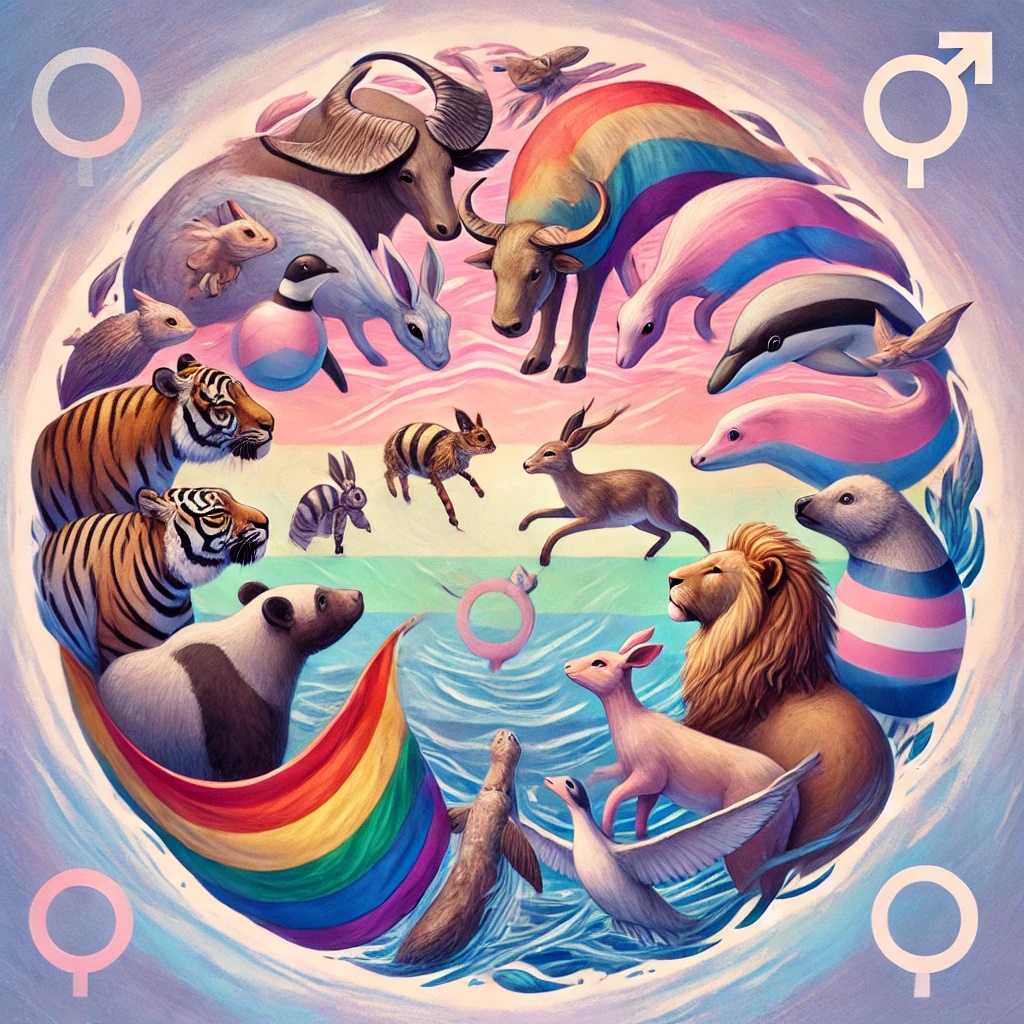
Pan-gender collaboration offers hope and evolution, which sees gender was a diverse and complicated spectrum rather than a flat, two-dimensional monochrome.
A pan-gender world
Workplace
If gender diversity is seen as a benefit and all identities aware respected and heard, the potential for creative problem solving within business must increase. If we only work with people who think and feel the same as us, we’ll always get the same kinds of solutions. Taking a pan-gender inclusive approach rewards business with greater imaginative resources.
Employees who feel respected and included by their employer are more loyal and more content in their role – and are more likely to devote extra energy to their jobs.
My experience
When I started to accept myself as a non-binary individual, I began to encounter others like me (or recognise that they exist) – but it also broke down the barriers between “men” and “women” I’ve found space for more open and honest connections with others.
I truly value what it means to be authentic and can encourage and support others to be likewise.
New interests
When I opened up to the complexity of my own inner world, I became curious about this others that didn’t fall into a binary gender lived and were treated in the past, discovering more about Byzantine eunuchs, the eunuchs of ancient Rome and Greece, Chinese imperial eunuchs, and the modern hijras of India.
There exists a broad experience of this “third gender” throughout history.
Relationships and emotional dynamics
Homosexual relationships have long challenged conventional ideas about gender roles – when both partners are the same sex, who’s job is it to put out the bins?
When a pan-gender spectrum is considered, gender roles can become even more meaningless. Couples (or other relationship styles) can work together to solve their common problems without being constrained by gender identity, instead identifying appropriate skills to address household chores.
A warning
Recognition doesn’t always help
In Byzantium, eunuchs were legally recognised as a distinct gender, but this recognition came with severe restrictions – exclusion from marriage, diminished rights, and a defined social role as submissive servants.
The hijras of India face similar challenges. While legally recognised, their rights are often undermined by social stigma and limited opportunities, revealing how legal categories can be a double-edged sword.
These examples force us to ask: Does legal recognition of gender diversity truly lead to equality, or does it trap people in predefined roles?
Legal solutions tend to be static
Legal definitions, by their nature, tend to fix identities in place. While recognising non-binary or third-gender categories may feel like progress, these categories risk becoming yet another box to fit into, limiting the ways people can express or live their identities.
What if we’re solving the wrong problem? What if gender, rather than being a legal identity to enforce or define, could be something fluid, self-determined, and not bound by the state?
Stepping away from the legal
What if we took a step further and did away with the legal definition of gender altogether? Without state-enforced categories, people could exist and collaborate based on their abilities, desires, and identities without being forced into predefined roles.
In a world of pan-gender collaboration, our focus would shift from enforcing boundaries to encouraging cooperation across all identities, allowing a more inclusive society to emerge.
Gender identity vs legal recognition
At the heart of the problem lies the difference between self-identification and state recognition. While laws may attempt to legitimise certain identities, true empowerment comes from within communities themselves. In this context, pan-gender collaboration provides a framework where individuals work together based on mutual respect, not on state-imposed labels. This is a future where we are freed from the trap of legal categorisation and can simply be ourselves.
Concerns
Some may worry that without legal definitions of gender, individuals could lose the protections and rights they have fought so hard for. But we must ask: Shouldn’t human rights be based on dignity and equality, rather than rigid gender categories?
In a world where pan-gender collaboration takes precedence, rights would – and must – be guaranteed to all individuals, regardless of gender, allowing for a more just and inclusive society
Conclusion
Rather than defining ourselves through rigid, state-enforced categories, let’s imagine a world where pan-gender collaboration guides us. Where people of all identities contribute their talents and perspectives, free from the limitations of legal gender. This shift away from fixed definitions could be the key to unlocking a more cooperative, inclusive future—one where we define ourselves by our shared humanity, not by the boxes we’re forced into.
 Eunuchorn
Leave a comment