
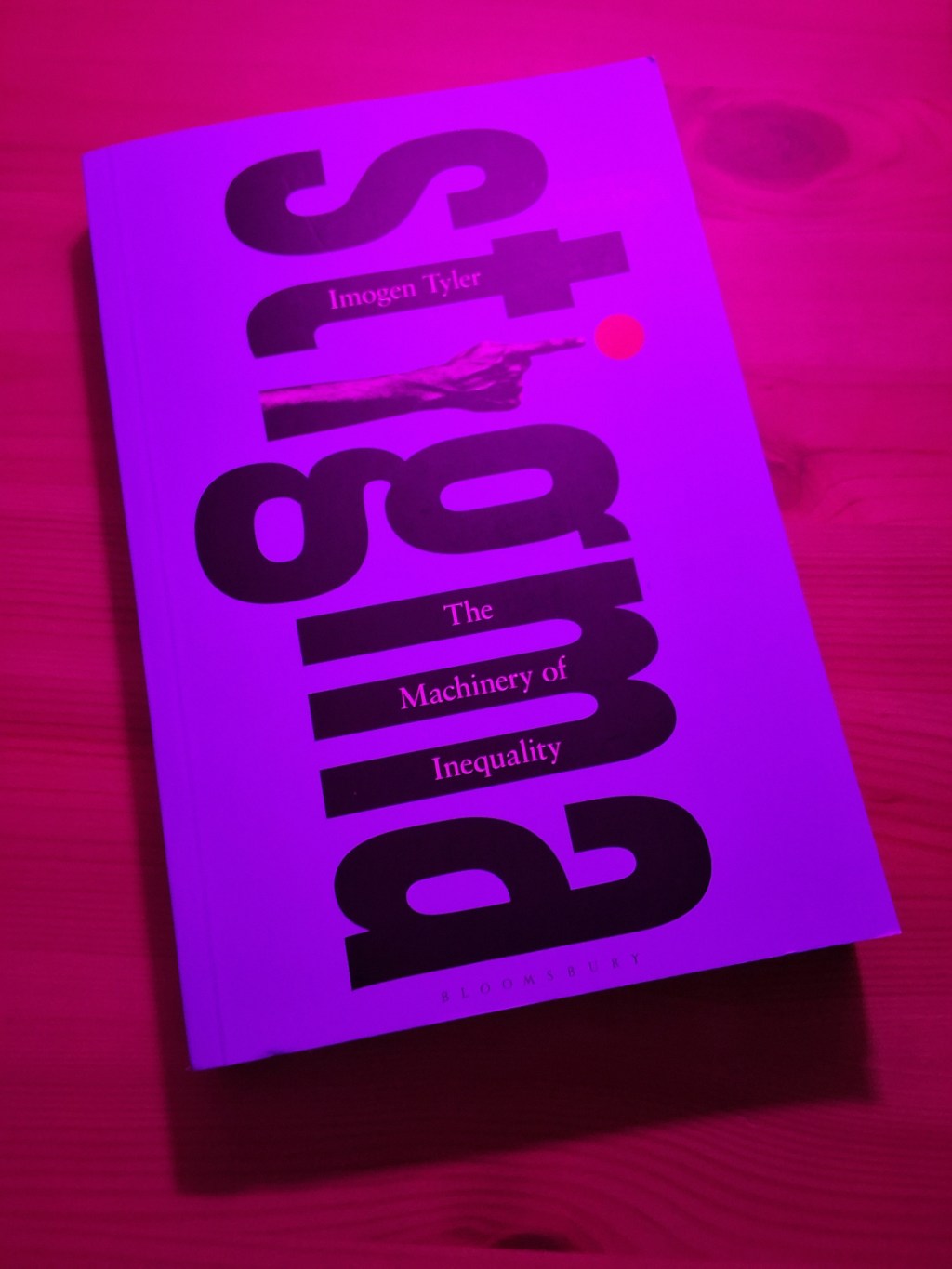
Continued from Stigma (book review) – Part 1 …
Stigma gives rise to resistance as people defend themselves against the shame which stigmatization seems to instil.
Page 226
I was altered to the stigma of the voluntarily castrated some time before my surgery; I was actually advised to read Hoffman’s book on “Stigma” to gain an understanding of what being stigmatised might mean. There have been a few times where I have had cause to suspect the I was being devalued due to being a eunuch. Persistence got me through.
…research suggests, that embracing the biogenic rather than social explanations of mental distress rights amplifying the very stigmatising attitudes and discriminations which these campaigns [eg the “Heads Together” campaign led by Princess Harry and William] ostensibly ask to eliminate.
Page 244
Simply put, one cannot therapise somebody out of poverty or disability. Society has to be willing and able to address the issues that underpin stigma – fair example, the attitude towards immigration is shared by poverty more than anything else.
in focusing on individual stories of disclosure and recovery, questions about the causes of stigma and mental distress are frequently airbrushed out of the picture.
Page 245
Charities and governments, in focusing on recovery from mental health, don’t take on the underlying issues of poverty, sexism, racism, disempowerment, homophobia, classism, ableism, or whatever else that exist as the cause of the mental illness, fall in status, discrimination, bullying, or anything else at the root of stigma in the first place.
For example, the volume of people in mental health being attended by the police increased by a third in the 2011-12 period. Services were deployed by austerity. People faced poverty and homelessness increased. Talking to the Samaritans won’t change the material facts of a person’s existence.
… stigmatization arises in contexts that are shared by unequal relations of power …
Page 246
My castration is felt by me as stigma wherever the doctor or another health official appears to treat me differently from his I think they will treat any other patient. Their power can accelerate, delay, or block my access to treatment. It is also very difficult to prove what motivated another human being to behave in a way that feels different from what I believe I would have experienced before castration.
The capitalist counter-revolution of neoliberalism is manifest in the re-emergence of authoritarian politics across the world today – in the mainstreaming of ethno-nationalism, in the ascendence of far-right supremacist politicians, parties and policies, in the cultivation of nostalgia for empire, in calls for “traditional” patriarchal and heteronormative social structures … and in the marked rise in racist, disablist and misogynistic forms of hate speech …
Page 266
The Brexit vote was characterised by highlighting the “other” in the form of immigrants, with the theory that they were “taking our jobs” or “sponging off the state”. It enabled politicians to say things that had been unthinkable only days before the campaign began, using increasingly incendiary speech, which ultimately led to the assassination of an MP.
In the short time preceding and during the campaign, there was an increase in hate crimes directed towards all minorities (see Hate Crime Statistics – House of Commons Library (parliament.uk)). There has been an increase year on year until 2023, when there was a drop. My personal experience is that I didn’t encounter any public abuse for being gay from the year 2000 through to 2018, when I began to encounter it again.
Conclusion
Stigma seeks to demonstrate that stigma machines as a capitalist device to extra labour from populations, whether classically enslaved or otherwise controlled via debt or other means. By seeing the application of stigma as a machine and its use in politics by politicians, the media, spin-doctors, think-tanks, and even states, we can see how racism, misogyny, disablist, and hate-speech – as well as homophobia and transphobia – additional insights can be drawn on slavery, “austerity”, and capitalism.
An interesting omission from this book is the use of castration to create a more compliant male, who would be unable to reproduce, would have familial allegiances other than the house to which he was indentured, and could create no dynastic rivalry. Therefore, eunuchs were trusted and civil servants, harem-keepers, and even generals.
Castration as a machine for creating an enslaved people would seem to be the perfect example of Imogen Tyler’s thesis, yet this is missing.
This book is educational, yet emotive. There were times when I was moved to tears over some of the things that our fellow humans have been made to – and are still made to – suffer.

 Eunuchorn
Leave a comment