
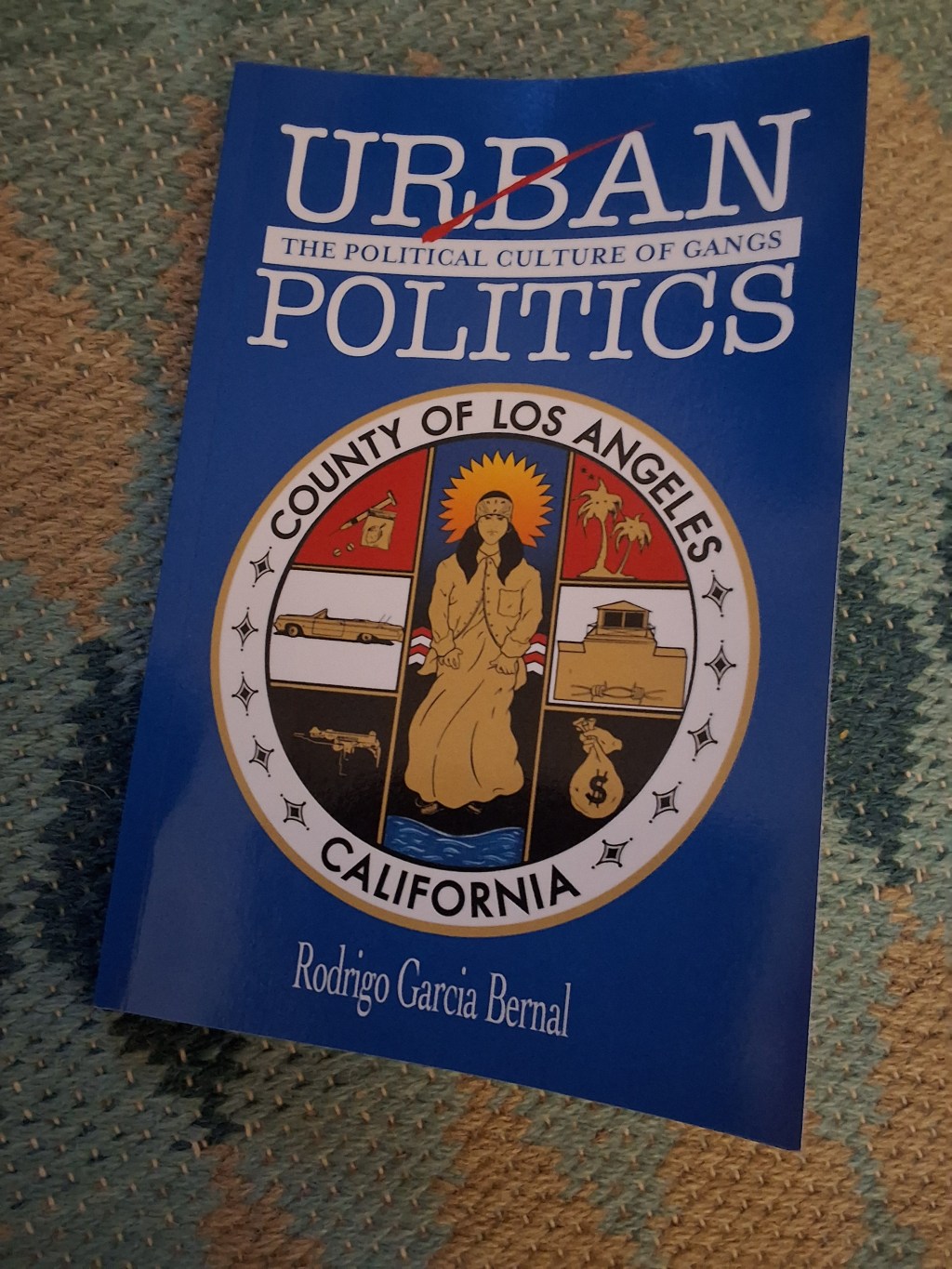
This book was recommended to me by the amazing person who preceded me to Mexico and fed back all that he learned from the expedition to make my own journey to transition so much safer and easier.
There was a time, a few months before this post was crafted, when there were journalists sneaking about our community attempting to infiltrate and expose us.
This friend of mine is a champion for the community, and suggested that I read this book to help prepare me against future attempts to get at us.
So, the question is “why this book?” … only one way I’m gonna find out!
Chapter 1: Social Contract
The book starts by describing the urban political landscape of the greater Los Angeles area, highlighting the massive differences in wealth and opportunities between sometimes adjacent areas.
This chapter describes the states within the state that are gangs. The author even describes the gang-as-entity as a “sovereign” that demands loyalty and wages war on its neighbours to gain territory – just like the kings of medieval Europe.
The agents of the actual state (eg the police, lawyers, and politicians)
…the influence of affluence…
Page 9
I loved this little semi-alliterating phrase. It pithily describes the motivation for much of any western society: the need to acquire and sometimes to conspicuously consume. Which creates competition between members of society to have the best and latest widgets.
When a social contract has been established through necessity, the 3 P’s are always fundamental principles for legitimate creation and involvement. They include: peace, prosperity, and protection.
Page 9
This made me think of our own eunuch communities. They exist to provide peaceful spaces for us to share our desires and our experiences. They become prosperous and grow, creating a rich sub-culture that is unique to the castrated and those who wish to enter that community as full members. The community also seeks to offer is members some protection: we are anonymous by default, we aim to provide practical advice and emotional support, and we defend the frontier against the invasion of those who would ask to harm or persecute us: whether that’s journalists or the agents of the state.
Within the book’s context, the 3 P’s, of course, related to gangs.
Chapter 2: Secret Societies
All secret societies throughout the world possess esoteric information whether it is technological, political, economical, religious, operational, metaphysical, etc… and use it to their benefit. … Some secret societies were formed to fight oppression and resisted tyrannical domination … thus, gang members who have worked cooperatively for the protection of the community and fought oppression and domination can be said to have formed a secret society based on subversive platforms.
Page 15
Our little online eunuch worlds are a form of secret society; we do share knowledge on how to effect the transition from male to eunuch, and how to live life in that most liminal of gender identities. Information on techniques for self-castration that are non-surgical are shared, as is information on how to maintain a healthy body without the native production of testosterone.
There are several such societies that operate on varying levels of secrecy and have different policies on who can be members and what member behaviour should look like.
A number of members of these societies have fought against political oppression and can therefore be described as having operated on subversive platforms. Or can they? Do subversive acts have to be clandestine? If they do, then some of our defenders, having such their heads above the parapet, are not subversives.
Secret societies speak in code, use signs and symbols, develop handshakes, sand inflict self-mutilation that become customs and norms.
Page 17
I rather object to becoming a eunuch (or nullo) being described as “self-mutilation”, but we are a secret society and we do have secret symbols – there’s the eunuch symbol (the male symbol with either a break between the circle and the arrow, or a line through the circle); although I’ve adopted the Eunuchorn was my secret symbol!
The genitally diverse communities, where body modification is sought after and praised, don’t perform modifications or undergo pain as part of the initiation, they are initiated because they have, or have a wish to, modify their body to suit their own needs and tastes.
As the name suggests, the Castrators of Russia u7sed self-mutilation was a way to achieve mystical insight.
Page 18
I can’t speak for everybody who has their testicles removed, but I’ve definitely become a much more reflective and thoughtful person since my castration – maybe there’s something in this “mysticism”.
…fornication with loose women…
Page 21
Yes, this book was published in the twenty-first century!
Secret societies everywhere have similar objectives: including the desire for power, love of mystery, sense of being somebody special, sense of belonging, an the feeling that one will gain something extraordinary from membership.
Page 24
I don’t think anybody in the eunuch community is after power or wealth – at least, they aren’t gonna find it in the community; however there is a sense that there is a mystery to becoming and living life as a eunuch – although was a dear friend once said to me “I am just as castrated when I’m washing the dishes”, meaning that even being a member of an exclusive secret society is mostly very mundane.
Not that the eunuch community is one homogenous group. There are a few population centres, which almost act like street gangs in their attitude to gaining members and animosity to other communities that are non-aligned with their own.
Such divisions are disappointing in so small a group – who’s every member is persecuted by the state and health authorities.
Section 3: Political Parties
This section left me reflecting on the divisions in the eunuch world; there are many ways to slice the pie:
By physical status
- Wannabe
- Ally
- Castrated
- Penectomy
- Nullo
These are semi-static, unambiguous attributes. Only a physical alteration can move a person between categories.
By motivation
- Body integrity (still identify as male)
- Eunuch gender identity
- Female (ie trans) gender identity
- Kink (submissive identity)
- Play (enjoy the excitement, but have no desire for castration)
- Religion (I’ve not encountered a religiously motivated eunuch yet)
- Medical
People will identify with one of more of these categories; they may adopt others, or drop one or more. A count of zero means that interest has been lost, and they remove themselves from the community.
Some memberships are probably mutually exclusive; I would suppose that a religious eunuch wouldn’t also be kinky … or at least wouldn’t openly admit it.
Those who are “serious” about castration might feel angry and concerned about people who “play” at it and regularly ask “what should I do with these?” posts.
By methods considered
- Professional surgeon
- Nonprofessional person (ie a “cutter”)
- Banding
- Stirring
- Injections
People considering professional surgery might be scared or worry about DIY methods and might sell their suppression as unsafe. Some DIY methods might regard others as less safe.
There are a number of online communities, here are some that I’m aware of:
- Discord
- FetLife
- Facebook (I know, right?!)
- Eunuch Archive
Again, people are often members of multiple sites, however, each site has a leader or group of leaders responsible for setting policy and maintaining order.
None of these are really political allegiances. They are more demographic divisions. Political parties are always exclusive and forbid membership of other parties.
Eunuchs are simply not organised enough to form parties within such a fragmented community.
Chapter 4: City Council Structure
The various online communities have “governments” responsible for setting policy, administering the site, and policing and law enforcement. Some sites have benevolent dictators, others have oligarchies.
Law enforcement will be administered as warnings, and temporary or permanent bans. Most of these online communities do not have an appeals process. Most will not explain it justify a member’s expulsion to the poor person suddenly finding themselves out in the cold.
Questioning the authority can also result in a ban.
Chapter 5: The Budget: Taxing and Spending
Since most eunuch related online communities are “owned” by an individual, and since ABT first would fall on an individual, the cheapest tier of service is usually chosen – which will be free.
The Eunuch Archive collects donations from is members to find it’s hosting services. I am unclear what members got in return for their donations, certainly not immunity from arbitrary expulsions.
At this point in the book, I found myself wondering whether the author was pushing the comparison between street gangs and national/city governments too far, however the author does list a number of areas and mechanisms that street gangs do not have that any government must have.
Chapter 6: types of policy and policy implementation
In order for the bureaucracy to have a well functioning rule-making process, policy implementation must be based on standards that are applicable to all individuals uniformly.
Page 47
It’s fascinating to think that fit a gang to become established and successful, that it must have a means of making and enforcing rules in a way that seems fare to members of the gang. They must understand that actions that go against these rules will be censured and a punishment handed out, which could be anything from a slapped wrist to a capital sentence.
We have nothing so well defined in the eunuch world. Each platform has a set of “terms and conditions”, however these are rarely read by members and their contents are slowly learnt from the precedent of example behaviour of other members.
Usually, transgression is punished by a “telling off” by an admin or moderator in the better run communities. In the despotic Eunuch Archive punishments are always exile from the community with no prospect of return.
Chapter 7: Congress and County Governments
At this point, I lose all ability to relate this book to the Eunuch Kingdoms.
However, I feel terrified by the American prison system, which this book seems to describe as an education system for criminals and essential to their career progression.
Chapter 8: The Underground Media
After the recent brush with the media poking around our community, this is a particularly interesting subject.
Print information is more analytical and complex because the reader can interpret the information based on his/her assessment, while television reporting focuses on people’s emotional spectrum; it is less complex in delivery sand interpretation of ideas, pandering to people’s desire for scandal, gossip, and conflict.
Page 69
Reading a book takes effort, but I feel that because of the reduced sensory noise, allows – indeed forces – the reader to think about they are taking in. Reading is an active message of taking in information.
… media that reports incomplete and sensationalist information that caters to people’s emotions, includes ideological polarization of reporting that it’s either too liberal or too conservative, expresses a professional journalism that is skewed based on reporters’ ideas of what is newsworthy, personal ideology, and the amount of audience interest.
Page 71
The owners of the media’s first priority is the continued existence of their newspaper/magazine/TV channel; to that end they will prefer need items that interest their subscribers. Reporters, if they value their job, will largely toe the company line as to what should be reported. This will naturally favour articles that are emotionally exciting.
That there are men who wish to become eunuchs or nullos would be a quite a coup for a media outlet that specialises in sensationalist reporting. Yet, we must engage with the media if we are put the wellbeing of our community into the public and therefore political awareness. However, with the current lack of sympathy in the media and therefore governing circles for the trans community, what hope for us?
To be part of a collective consciousness is to be part of a global community, regardless of it’s a subversive counterculture, and many people do not want to pass up this opportunity or feel as though they are missing out on something bigger than themselves.
Page 82
I love my eunuch community. This has come to be the “bigger than me” that I needed. It’s something for which I can fight, and that sorts me in times of trouble.
Chapter 9: Interest Groups
The police aren’t being very favourable described! Corruption and brutality over a period of one hundred years. Street gangs sometimes sometimes refer to policeman as “gangsters with badges”, which hardly encourages cooperation and trust. The police reaction to cop killing goes beyond justice and into the land of vendetta, which causes a like reaction from the now victimised gang. The cycle continues. The police are powerless because they are part of the problem – like the Royal Ulster Constabulary, which had to be dismantled and replaced as part of putting an end to the troubles in Northern Ireland.
Conclusion
This was an interesting book and an easy enough read, however the terms used became confusing. I completely understand that the author wished to liken street gangs to mini-city governments, since many of the functions of city governance were duplicated, however, since the gangs operated within the context of a real political city, the terms became confusing to me.
In my opinion, the street gangs operated more like medieval principalities, rather than democratic civilian operations. The takes of constant war being reminiscent of the endless conflicts of the Middle Ages.
It might also be worth noting that democracies very rarely go to war with one another (it’s not unheard of, but it is rare). These gangs are in an unending conflict with one another.
It was an interesting exercise relating the street gangs to the various eunuch online communities, but there was only so far that I could take the similarities. The online communities are small and lack cohesion. As far as I am aware, only the Eunuch Archive has sufficient organisation to require managing accounts and regular fund raising.
Conversation with Tacitus about the book
My friend, Tacitus, recommended that I read this book after the recent encounter with journalists attempting to infiltrate our community. I told him that I’d finished, then we had a bit of a chat about it and what we take from the book to help understand our community.
It is possible that online communities cannot operate like physical tribes. If that is so, it may forever limit the cohesiveness and integrity of the online community.
Within the community, for most of the castrated or postulants amongst us, it is relatively easy to “pass” in wider society, so issues of identity are less obviously a problem observable by the general public and are thus a less pressing issue that things like work or family. As Tacitus says “we do not have to establish a ghetto to stay alive”: this is an important observation.
Another aspect of the needs of the members of our online communities is that no member requires the community to provide all, or a significant portion, of their needs.
This isn’t true for everybody – some members are in an agony of identity and body integrity.
There I suspect that a major problem with “the community” is that with so many kinksters, who enjoy castration play, that the voices of eunuchs and true wannabes are lost. If that is so, then the question of what kind of community could give these people a voice?
My friend Tacitus is also exploring the problem of the ideas of gender in our modern society that make it difficult to say to the world at large “I would like my body modified in this way”.
Part of my reading of this book and exploring the thoughts it brought up made me really appreciate that “we” (ie the eunuch world) aren’t a homogenous bunch of people: there are many tribes within our community, some with diametrically opposing goals.

 Eunuchorn
Leave a comment